Horse Racing Betting Glossary: 100+ Terms Every UK Punter Should Know
Best Horse Racing Betting Sites – Bet on Horse Racing in 2026
 Available in US

Horse Racing Has Its Own Language — This Glossary Translates It
Horse racing is the second-largest spectator sport in Britain after football, measured by attendance, employment and revenue. The DCMS Select Committee itself described the relationship plainly: racing is interlinked with the gambling sector, with fixture lists and race programmes shaped directly by the need to provide a consistent betting product. That deep integration has produced a vocabulary unlike any other sport — a layered dialect of bookmaking jargon, course terminology, form shorthand and breeding references that can leave even enthusiastic newcomers completely lost.
I compiled this glossary from the terms I wish someone had explained to me when I started. It covers the language you will encounter on racecards, in betting shops, on exchange platforms and in form commentary. Each entry is written to be understood without prior knowledge, and where a term connects to a broader concept, I have said so.
Recommended online casinos
- BeOnBetBonus: 100% up to €500 + 100 FS · Payout speed: 1-3 business days
- Revery PlayBonus: 100% up to€1,000+ 100 FS · Payout speed: 1-3 business days
- ChanzeBonus: Slots Welcome Bonus #1 200% up to €500 · Payout speed: 1-3 business days
- JetsetspinsBonus: 200% Bonus + 100 Free Spins + Free Royal Wheel · Payout speed: 1-3 business days
- DieselwinBonus: Welcome Pack 250% up to £4000 + 200 FS · Payout speed: 1-3 business days
- ZombillionBonus: Welcome Pack 250% up to £4000 + 200 FS · Payout speed: 1-3 business days
- WinBeastBonus: €5000 + 500 FS + €650 Freebet · Payout speed: 1-3 business days
- NightWinBonus: £900 + 400 free spins · Payout speed: 1-3 business days
- SpinFormulaBonus: 550% Up To £15,000 + 550 FS · Payout speed: 1-3 business days
A-D: From Accumulator to Dutching
Accumulator (Acca) — A single bet combining four or more selections, where each must win for the bet to pay out. The odds multiply, but so does the overround, making long accumulators mathematically punishing.
All-Weather (AW) — Racing on an artificial surface (Polytrack, Tapeta or Fibresand) rather than turf. All-Weather tracks in the UK include Kempton, Lingfield, Wolverhampton, Chelmsford, Newcastle and Southwell.
Ante-Post — A bet placed well before race day, usually on a future event like the Cheltenham Gold Cup or the Derby. Ante-post bets typically offer longer odds but carry non-runner risk: if the horse does not run, the stake is lost unless NRNB terms apply.
Best Odds Guaranteed (BOG) — A bookmaker promotion that pays the higher of the price you took and SP if the starting price drifts above your odds. Standard across most major UK bookmakers for horse racing.
Brought Down (BD) — A horse that falls or is brought down by another horse during a jumps race. Recorded in the form as “BD” and tells you nothing about the horse’s ability on the day.
Bumper — A National Hunt flat race, run without obstacles. Used to introduce young jumps horses to the racecourse. Form from bumpers tells you about a horse’s raw ability and temperament but nothing about its jumping.
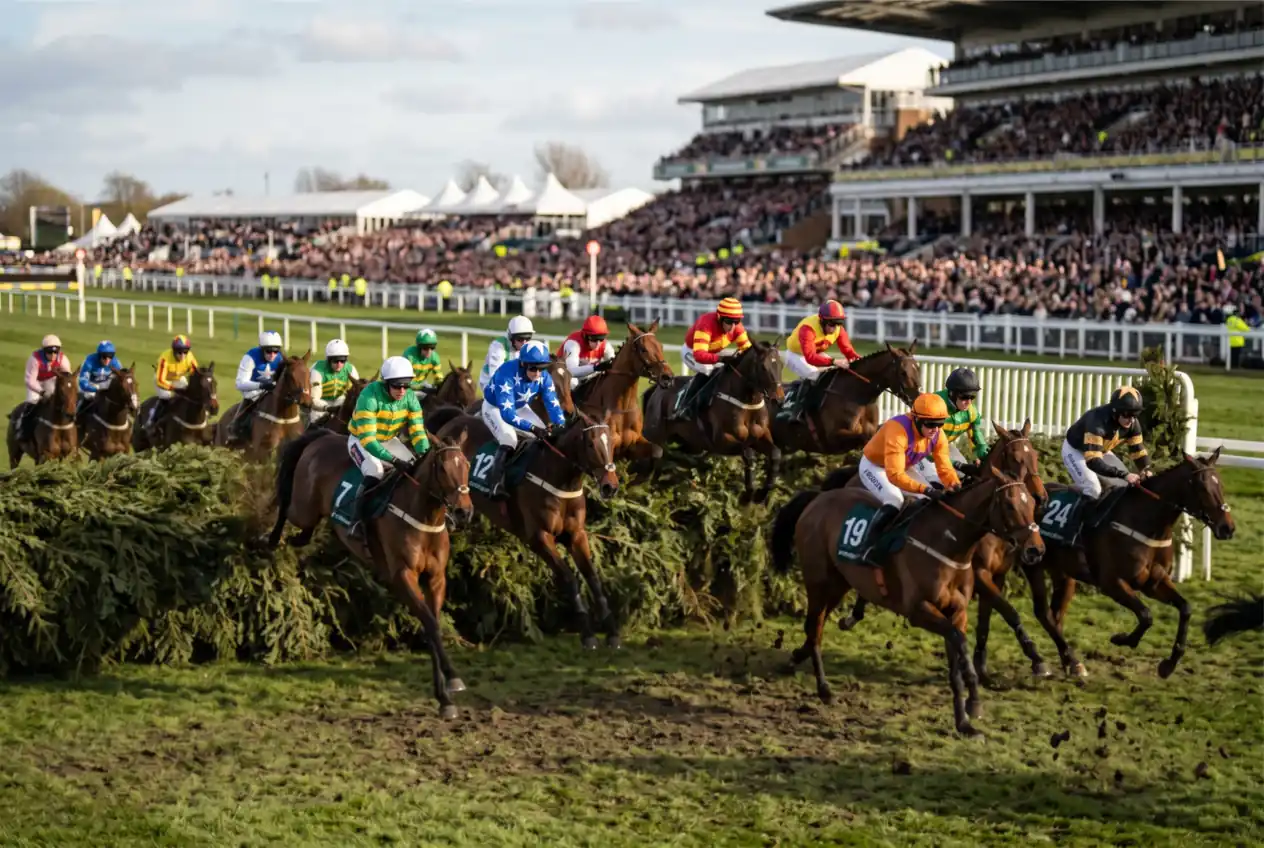
Chase — A steeplechase, run over larger fences than hurdles. Distances range from about two miles to over four miles in extreme cases like the Grand National.
Claimer (Claiming Jockey) — An apprentice (Flat) or conditional (Jumps) jockey who receives a weight allowance — typically 3lb, 5lb or 7lb — due to limited experience. The allowance can give a horse a meaningful advantage in handicaps.
Conditions Race — A race where weights are allocated by age and sex rather than by the handicapper. Group and Listed races are conditions races. The field quality tends to be more uniform than in handicaps.
Dead Heat — When two or more horses cannot be separated at the finish line, the judge declares a dead heat and stakes are divided accordingly.
Declarations — The process by which trainers confirm a horse will run. Final declarations are typically made 24-48 hours before the race.
Dutching — Backing multiple horses in the same race with calculated stakes to produce the same profit regardless of which selection wins. Used when you cannot separate two or three contenders and believe the combined probability exceeds the market’s pricing.
E-L: From Each-Way to Lay Bet
Each-Way (E/W) — Two bets in one: a win bet and a place bet, at equal stakes. The place part pays a fraction of the odds (typically 1/4 or 1/5) if the horse finishes in the first two, three or four depending on the race conditions shown on the racecard. Enhanced place terms in big-field handicaps extend coverage to five or six places.
Forecast — A bet predicting the first and second horses in the correct order (straight forecast) or in either order (reverse forecast). A combination forecast covers multiple horses in first and second positions.
Form Figures — The string of numbers next to a horse’s name on a racecard, showing recent finishing positions. A “1” means the horse won; “0” means it finished tenth or worse; “/” separates seasons; “F” means fell; “U” means unseated rider; “P” means pulled up.
Going — The official description of ground conditions: firm, good to firm, good, good to soft, soft, heavy on turf; standard, standard to slow, slow on All-Weather. The going profoundly affects race outcomes and is measured by GoingStick readings.
Handicap — A race where the handicapper assigns different weights to each horse based on its official rating, aiming to give every runner a theoretically equal chance. The most competitive race type in UK racing.
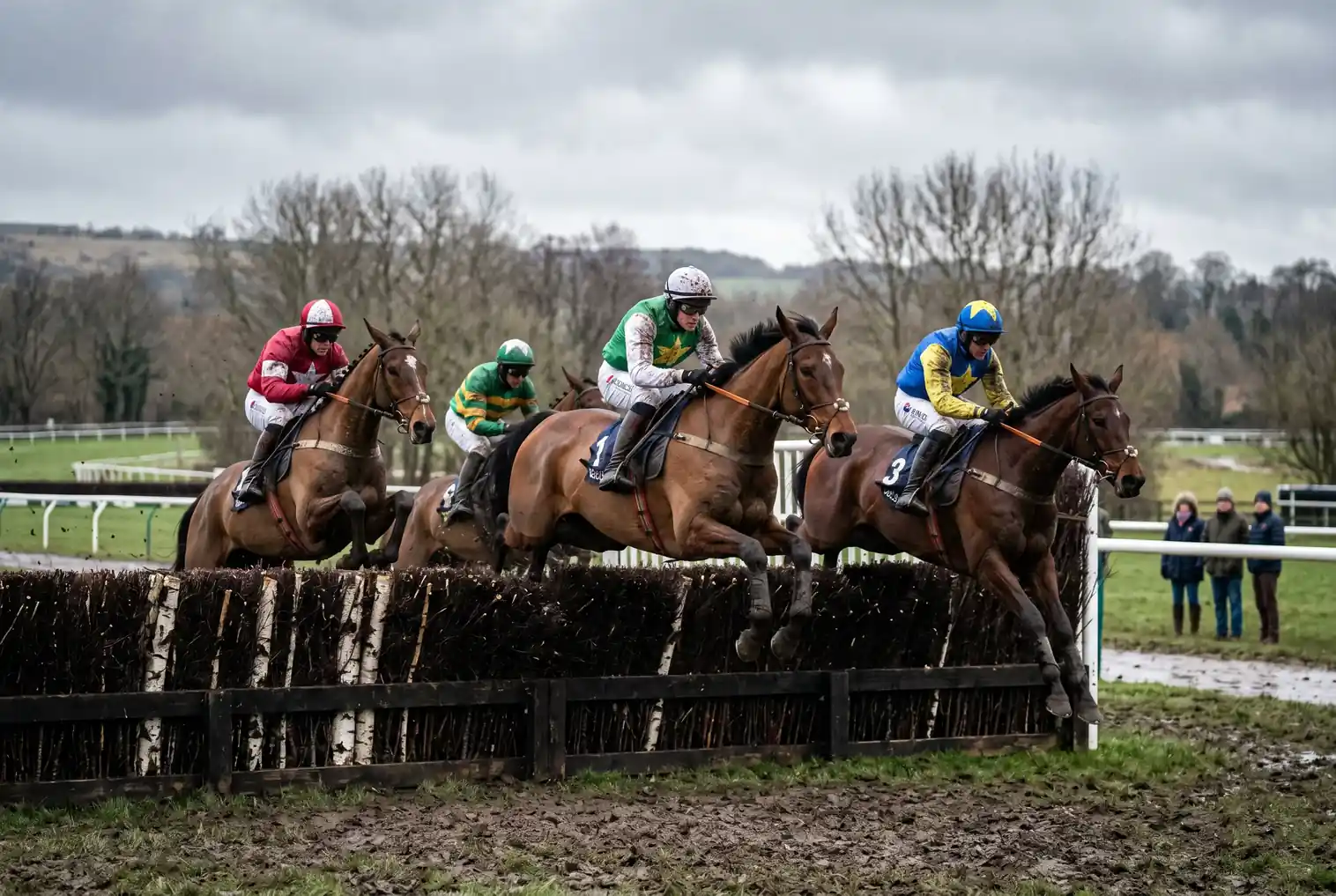
Hurdle — A smaller obstacle (about 3.5 feet) used in National Hunt racing. Hurdle races are generally shorter and faster than chases.
In-Play (In-Running) — Betting that takes place after the race has started. Available on exchanges and some bookmaker platforms, with odds changing in real time as the race unfolds.
Jolly — Slang for the favourite in a race.
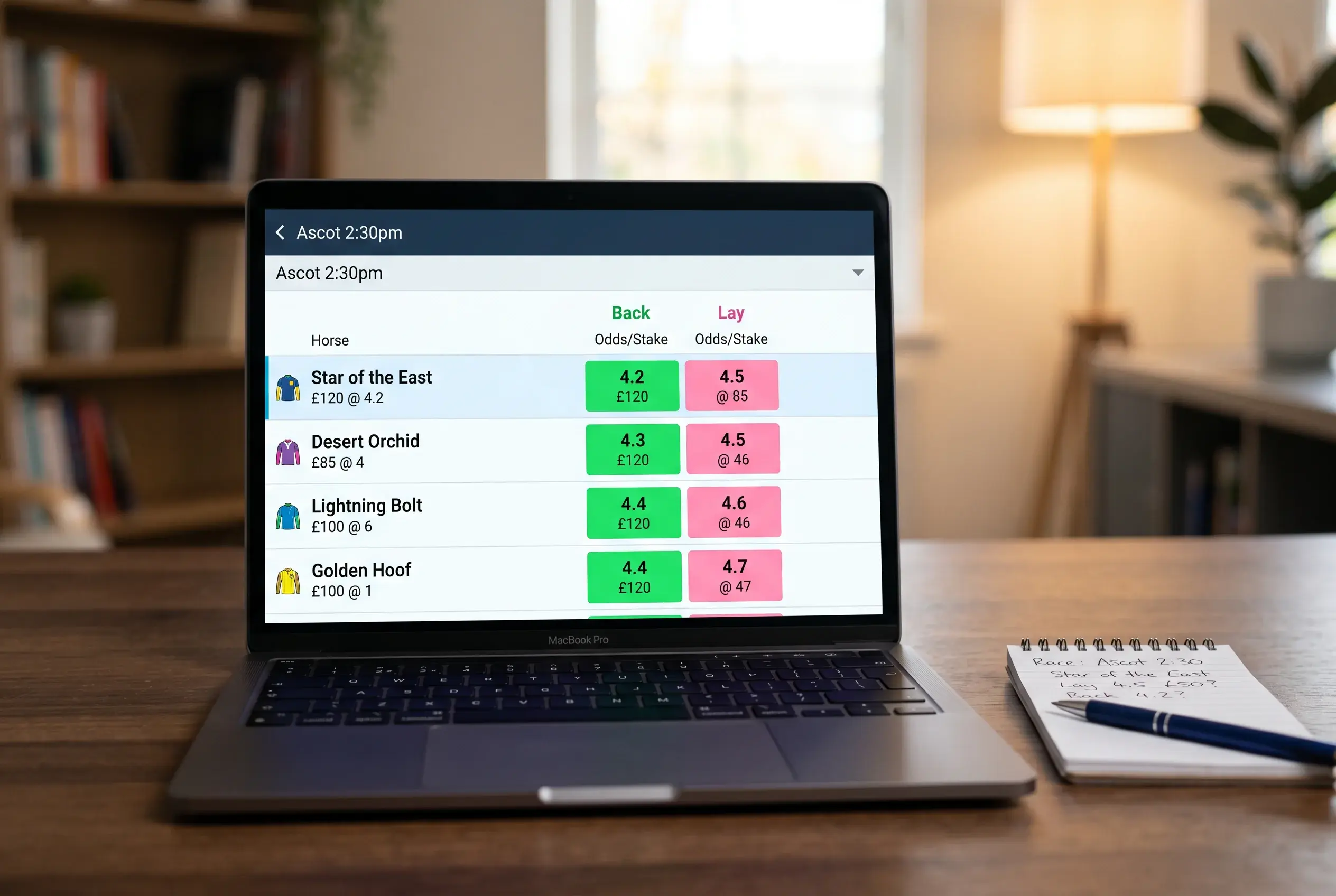
Lay Bet — A bet against a horse winning, available on betting exchanges. You profit if the horse loses, but your liability is higher than a standard back bet if the horse wins.
M-R: From Market Mover to Rule 4
Market Mover — A horse whose odds are shortening significantly, suggesting it is attracting heavy support from backers. A genuine market mover at a major bookmaker is a stronger signal than movement on smaller or exchange-only markets.
Maiden — A horse that has not yet won a race. A maiden race is restricted to such horses.
Nap — A tipster’s strongest selection of the day, named after the card game Napoleon. Published daily in newspapers and tracked in nap league tables.
Non-Runner (NR) — A horse that was declared to run but is withdrawn before the race. If you backed a non-runner, most bets are void and the stake is returned — unless it was an ante-post bet without NRNB protection.
NRNB (Non-Runner, No Bet) — An ante-post term meaning your stake is refunded if the horse does not run. Offered by bookmakers at shorter odds than standard ante-post.
Official Rating (OR) — A number assigned by the BHA handicapper reflecting a horse’s assessed ability. Used to determine the weight a horse carries in handicap races. Ratings typically range from 0 to 175.
Overround — The bookmaker’s built-in margin, expressed as a percentage. An overround of 120% means the book is 20% over a “fair” market, and that 20% represents the theoretical profit margin for the bookmaker.
Place — A finishing position that qualifies for a payout on the place part of an each-way bet. In fields of five to seven runners, the first two places pay; in eight or more, the first three; in handicaps of 16 or more, the first four.
Pull Up (PU) — A horse that was deliberately stopped during a race, usually because it was beaten or injured. Recorded in the form as “PU.”
Rule 4 — A deduction applied to winning bets when a horse is withdrawn from a race after the final market has been formed. The deduction depends on the odds of the withdrawn horse: the shorter the price of the non-runner, the larger the deduction from your payout.
S-Z: From SP to Yielding
SP (Starting Price) — The official odds of a horse at the moment the race begins, determined by the on-course market. If you do not take a fixed price, your bet settles at SP. The segmentation of UK racing bets shows win bets account for 36% of all racing wagers, each-way 22%, forecast and tricast 17%, singles 15% and multiples 10% — and many of those settle at SP when no early price is taken.
Steamer — A horse whose odds are contracting rapidly. The opposite of a drifter, whose price is lengthening.
Staking Plan — A systematic approach to how much you bet. Common methods include flat staking (same amount every time), percentage staking (a fixed proportion of your current bank) and the Kelly Criterion (a formula that sizes bets based on perceived edge and odds).
Tissue Price — The odds a bookmaker’s compiler sets as an initial estimate before the market opens. Tissue prices are the bookmaker’s private assessment of each horse’s chances and form the starting point for the morning market.
Tote — The UK’s pool betting operator. Tote bets are pooled together and dividends are calculated after the race based on the total pool minus a deduction. Tote payouts can exceed bookmaker SP when the winner is less popular with pool bettors.
Tricast — A bet predicting the first three horses in the correct finishing order. The combination tricast covers all possible orderings of your selected horses. Payouts can be substantial in competitive handicaps.
Under Rules — Racing that takes place under the jurisdiction of the BHA (British Horseracing Authority). Distinguishes official racing from point-to-points, which operate under different governance.
Value Bet — A bet where the odds offered exceed the true probability of the outcome. A horse with a 25% chance of winning priced at 5/1 (implied probability 16.7%) represents value; the same horse at 3/1 (25%) does not.
Weighed In — The official confirmation after a race that the jockeys have weighed in at the correct weight, triggering the payout of winning bets. Until “weighed in” is announced, results are provisional.
Yielding — A going description used primarily in Irish racing, roughly equivalent to “good to soft” on the UK scale. Relevant for punters assessing Irish form before UK races.
What does SP mean on a betting slip?
SP stands for Starting Price — the official odds at the moment the race begins. If you place a bet at SP rather than taking a fixed price, your returns are calculated at whatever the starting price turns out to be. Best Odds Guaranteed promotions protect you if SP is higher than the price you took, but not if SP is lower.
What is the difference between odds against and odds on?
Odds against means the potential profit exceeds your stake — for example, 3/1 returns three pounds profit for every pound staked. Odds on means you risk more than you stand to profit — for example, 1/3 requires a three-pound stake to win one pound. Odds-on horses are expected to win but offer smaller returns.
What does Rule 4 mean and how does it affect my payout?
Rule 4 is a deduction applied to your winnings when a horse is withdrawn from a race after the market has been set. The deduction compensates for the removal of a competitor from the field. The amount depends on the odds of the withdrawn horse: a short-priced non-runner triggers a larger deduction (up to 90p in the pound for an odds-on favourite) while a longshot withdrawal results in little or no deduction.
The full picture is in our data-driven guide to horse racing betting.
The terms in action: how to read a racecard.
Prepared by the Tips for Horse Racing Betting editorial staff.