Horse Racing Form Guide: How to Read Past Performances and Find Hidden Contenders
Best Horse Racing Betting Sites – Bet on Horse Racing in 2026
 Available in US
Table of Contents
- What a Form String Actually Tells You — and What It Hides
- Decoding UK Form Figures: Numbers, Letters and Symbols
- Class, Distance and Course Form: The Three Filters That Narrow the Field
- How Going Preferences Transform a Horse’s Chances
- Recommended online casinos
- Trainer and Jockey Angles: When Connections Signal Intent
- Speed Ratings and Sectional Times: Adding a Quantitative Layer
- Putting It Together: A Step-by-Step Form Analysis of a Real Race
- Frequently Asked Questions
What a Form String Actually Tells You — and What It Hides
I once backed a horse with a form string that read 1-1-2-1. Four runs, three wins, a second. Looked bulletproof. It finished tailed off in ninth, beaten over twenty lengths. What the string did not reveal was that those wins came on heavy ground at Sedgefield in Class 5 company, and this race was a Class 3 on good-to-firm at Newbury. The form was real — the context was missing entirely.
That is the fundamental tension with form analysis. The raw string gives you a compressed history of results, and most punters treat it like a report card. High numbers look bad, low numbers look good, and the letter P means something went wrong. On the surface, it is that simple. In practice, the string is closer to a coded message that only makes sense when you decode every variable surrounding those results — the ground, the class, the distance, the jockey booking, the race conditions, the margin of victory or defeat.
Favourites in British racing win roughly 30–35% of the time, and that figure stays remarkably stable across decades. The market gets the broad picture right more often than not. But the market also prices horses on popularity and recency bias as much as on rigorous analysis. Your edge, if you are going to find one, lives in the details the form string compresses or omits entirely. This guide breaks down every element of UK form reading — from the basic symbols to the advanced filters that separate serious analysts from casual punters scanning numbers on a racecard.
I have spent nine years reading form almost every day, and the single most important lesson is this: form is not about finding the horse with the best record. It is about finding the horse whose record is better than the market thinks.
Decoding UK Form Figures: Numbers, Letters and Symbols
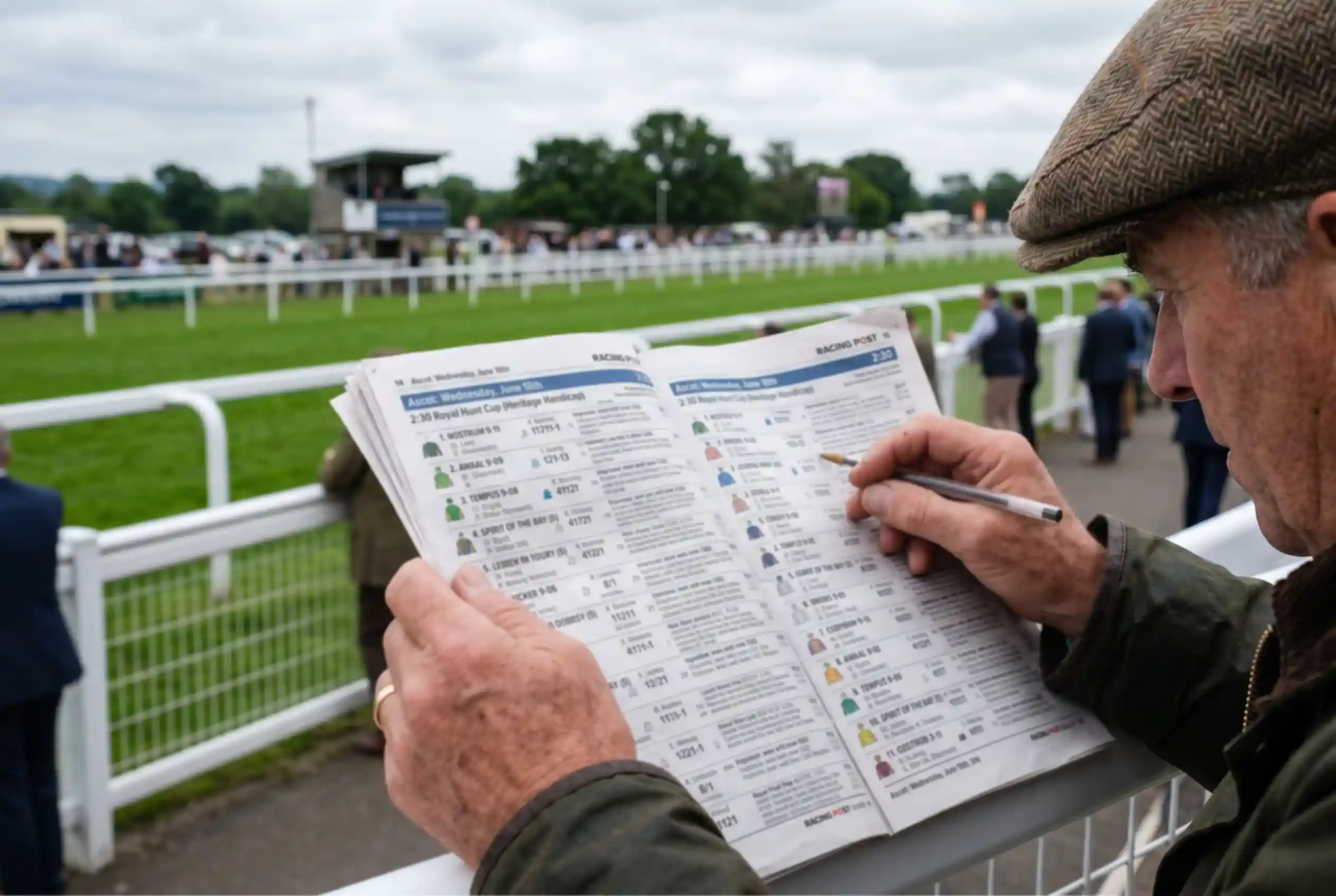
The first time I sat down with a Racing Post racecard and tried to make sense of the form column, I felt like I was reading someone else’s shorthand. Numbers mixed with letters, slashes, dashes — it looked arbitrary. It is not. Every character follows a strict convention, and once you learn the alphabet, racecards become transparent.
The numbers are the simplest part. A “1” means the horse won its last race. A “2” means second, “3” means third, and so on up to “9”. If the horse finished tenth or worse, it appears as “0”. The most recent result sits on the right-hand side of the string, so a form line of 43021 tells you the horse finished fourth, then third, then unplaced, then second, and last time out it won. You read left to right as oldest to newest.
Slashes separate racing seasons. A form string like 21/310 means the horse had two runs last season (finishing second and first) and three runs this season (third, first, unplaced). That slash is more important than most punters realise. A break between seasons can mean a layoff of several months, and horses returning from breaks perform differently to horses in the middle of a campaign. The longer the gap, the more uncertain the fitness.
Letters carry specific meanings. “F” is a fall, “U” is unseated rider, “P” is pulled up, “R” is refused, “B” is brought down, and “S” is slipped up. Each one tells a different story. A fall in a steeplechase might be bad luck or bad jumping technique — you need to watch the replay to know which. A pull-up could mean injury, breathing problems, or simply a horse that was so far beaten the jockey stopped riding. “C” next to a number means the horse won at the course before, and “D” means it has won over today’s distance. “BF” stands for beaten favourite, which flags that the market expected this horse to win and it did not deliver.
There are subtleties that trip people up. A “t” after a number indicates the horse wore a tongue tie. Headgear changes — blinkers, cheekpieces, visors — sometimes appear in the racecard notes rather than the form string itself, but they matter. A first-time blinker application is one of the strongest gear-change signals in UK racing. The horse’s connections are trying something new, and the stats on first-time blinkers show a measurable uplift in win rate compared to horses without headgear changes.
Here is a quick example. The form string 2F1/43-1C reads as follows: two seasons ago the horse finished second, fell, then won. Last season it finished fourth, third, had a break (the dash represents a gap between runs), then this season won at the course. That “C” is a strong positive — the horse handles this track. The fall from two seasons ago may or may not matter depending on whether it was over fences and whether the horse has jumped cleanly since. Every character in the string prompts a question, and answering those questions is the actual skill of form reading.
Why Last Three Runs Matter More Than Career Stats
A colleague of mine used to track every runner at Cheltenham in a spreadsheet, logging career win rates going back to maiden races. His results were mediocre. Mine improved the day I started ignoring anything older than three runs.
Recency matters because horses are not static performers. They improve, they regress, they get injured, they change yards, they develop preferences. A horse that was winning Class 4 handicaps two years ago might have been raised 15lb in the ratings and is now competing against far better animals. Its career stats still look solid — say, five wins from twenty starts — but its recent form of 0-0-7 tells you it cannot compete at its current mark. The career stat is noise; the last three runs are signal.
The second and third favourites in UK racing win about 20% and 13% of the time respectively. Together, the top three in the betting account for roughly 65–70% of all winners. What this means practically is that the market is decent at identifying the main contenders, and those contenders are almost always horses whose recent form reads well. You very rarely see a horse trading at the head of the market on the back of good form from eighteen months ago. The market discounts old form naturally.
Three runs is a guideline, not a fixed rule. For horses returning from a long absence, even one run back can be more informative than nothing. For prolific campaigners on the all-weather circuit who run every two weeks, five or six recent runs might be more appropriate. The principle is the same: weight recent evidence more heavily, but understand the context of that evidence. A horse finishing sixth of fourteen last time out in a Class 2 at York is almost certainly a stronger form line than a horse winning a Class 5 at Wolverhampton. Numbers without context are just numbers.
Class, Distance and Course Form: The Three Filters That Narrow the Field
Every punter has a story about a horse that dominated at one track and flopped at another. Mine involves a sprinter that won three times at Chester — a tight, left-handed, flat track with a sharp bend — and then finished last at Ascot on its first try over a straight course. Same distance, same ground, same jockey. Completely different track geometry, completely different result. Course form is not a nice-to-have detail. It is a structural filter that eliminates horses before you even look at their speed figures.
Class is the hierarchy of UK racing, running from Class 1 (Group races, the elite) down to Class 7 (the lowest-grade races on the calendar). A horse dropping in class is often called a “class dropper,” and these moves are among the most reliable angles in form analysis. When a trainer deliberately places a horse in a weaker race after it has been competing at a higher level, the horse effectively faces easier opposition. The form book might show recent results of 5-7-4 in Class 3, but in a Class 5 race those efforts could represent a significant edge over the field. Conversely, a horse stepping up in class for the first time is an unknown quantity. It might handle the rise, or it might discover that the pace and quality at the higher level are simply beyond it.
Distance preferences are partly genetic and partly learned. Sprinters — horses racing over five and six furlongs — tend to have explosive early speed but lack stamina. Stayers, running over two miles or more, are built to sustain effort rather than accelerate sharply. Most horses have an optimal distance range, and the form book reveals it over time. A horse that consistently finishes strongly over a mile but weakens in the final furlong over a mile and a quarter probably wants to stay at a mile. A horse that leads over seven furlongs but gets caught in the last hundred yards might need to drop back to six.
In fields of six runners, public favourites win close to 40% of the time at an average price just above even money. In fields of twelve, that win rate drops to around 27% at roughly 2/1. This data point matters here because it tells you something fundamental: smaller fields reduce variables, and class differences become more pronounced. In a six-runner Group race, the class of horse is relatively homogeneous, and distance and course suitability become the separating factors. In a large-field handicap with sixteen or more runners, class is supposedly equalised by the weights, and course form, draw, and going preferences carry more influence.
I filter every race through a three-step sieve. First, has this horse proven it can compete at today’s class level or higher? If not, it goes to the bottom of the shortlist. Second, does the distance match the horse’s profile — not just by the headline trip, but by the way it runs its races? Third, does it have form at this course, or at a course with similar characteristics? A horse with good form at Epsom, for instance, might handle Brighton because both tracks are undulating and left-handed. A horse that loves Pontefract might suit Beverley. These track analogies are not perfect, but they are better than ignoring course form altogether.
When all three filters align — proven at the class, suited by the distance, comfortable at the course — you have a horse whose form profile genuinely matches the race conditions. That alignment does not guarantee a winner, but it reduces the field of serious contenders dramatically. Most races have three or four horses that tick all three boxes. Finding the one the market has underestimated is where form analysis becomes value analysis.
How Going Preferences Transform a Horse’s Chances
I lost money for an entire winter before I properly understood going. Not the concept — everybody knows soft ground is different from firm ground — but the degree to which it changes outcomes. A horse with a win rate of 35% on good ground can drop to single digits on heavy. That is not a marginal effect. That is the difference between a contender and an also-ran.
The UK going scale runs from hard (extremely rare, almost never declared) through firm, good-to-firm, good, good-to-soft, soft, and heavy. National Hunt racing in winter frequently produces soft and heavy ground, while the Flat season from April to October typically sees good or faster. All-weather surfaces — Polytrack, Fibresand, Tapeta — have their own characteristics and are generally consistent regardless of weather.
Going preferences are partly about a horse’s physical build and partly about its action — the way it moves. Horses with a low, daisy-cutting action tend to prefer faster ground because they skim across the surface. Horses with a higher, rounder knee action cope better with soft ground because they pick their feet up out of it. You can sometimes spot this by watching replays, but the form book provides a more reliable record. If a horse has run six times on soft ground and never finished in the first three, it does not want soft ground. The replays might show you why; the form book shows you that it is consistent.
Favourites win around 30–35% of the time across all ground conditions, but that figure masks a key detail. On ground that horses are proven to handle, their strike rate climbs. On ground that does not suit them, it collapses. The market adjusts for going to some extent — you will see prices shorten on horses with good soft-ground form when rain arrives — but the adjustment is often incomplete, particularly in the early markets when the going description might change before race time.
One practical tip that has served me well: cross-reference the going on the day with the going at each of the horse’s previous wins. If a horse has won twice on good-to-soft and once on soft, and today’s ground is good-to-soft, you have a proven surface match. If its only victories came on good-to-firm and today it is soft, you are hoping rather than analysing. I mark going preferences in my notes as “proven,” “untested,” or “negative,” and I rarely back a horse on ground where it has a negative record, regardless of how good the rest of its form looks.
Recommended online casinos
- BeOnBetBonus: 100% up to €500 + 100 FS · Payout speed: 1-3 business days
- Revery PlayBonus: 100% up to€1,000+ 100 FS · Payout speed: 1-3 business days
- ChanzeBonus: Slots Welcome Bonus #1 200% up to €500 · Payout speed: 1-3 business days
- JetsetspinsBonus: 200% Bonus + 100 Free Spins + Free Royal Wheel · Payout speed: 1-3 business days
- DieselwinBonus: Welcome Pack 250% up to £4000 + 200 FS · Payout speed: 1-3 business days
- ZombillionBonus: Welcome Pack 250% up to £4000 + 200 FS · Payout speed: 1-3 business days
- WinBeastBonus: €5000 + 500 FS + €650 Freebet · Payout speed: 1-3 business days
- NightWinBonus: £900 + 400 free spins · Payout speed: 1-3 business days
- SpinFormulaBonus: 550% Up To £15,000 + 550 FS · Payout speed: 1-3 business days
Trainer and Jockey Angles: When Connections Signal Intent
About 80% of races are won by the top 20% of trainers and jockeys at any given track. That statistic hit me harder than any other when I first encountered it, because it reframes how you weight connections in your form analysis. You are not looking for a marginal advantage. You are looking at a structural feature of the sport: a small group of professionals wins the vast majority of races, and everything outside that group is fighting for scraps.
Trainer form is seasonal, cyclical, and yard-specific. Some trainers — particularly the larger Flat yards — have their horses ready to run early in the season and hit the ground running in April. Others peak later, timing their major targets for Royal Ascot in June or the Glorious Goodwood meeting in late July. Over jumps, certain trainers dominate the autumn, while others build towards the Cheltenham Festival in March. Tracking a trainer’s seasonal pattern over two or three years gives you a template that repeats more reliably than individual horse form.
The Horserace Betting Levy Board noted that bookmakers’ gross profits ran above recent averages in February and March 2025, with results at the Cheltenham Festival particularly favouring the layers. That is another way of saying: punters backed too many fancied runners from top trainers and those trainers did not deliver as the market expected. Trainer reputation inflates prices. Being aware of when a yard is genuinely firing and when the market is trading on name alone is a form reading skill that most people overlook.
Jockey bookings carry a different type of information. The key is not who the jockey is — though obviously a booking from a champion jockey is a positive — but whether the booking has changed. A horse that has been ridden by a claiming apprentice in its last three races and suddenly has a senior jockey booked is sending a signal. The trainer is investing in a better ride, which usually means the trainer expects a better performance. The reverse is also informative: a horse dropped from a retained rider to a lesser-known jockey might be running without serious expectations.
Trainer-jockey combinations are worth tracking as a subset of this analysis. Certain partnerships produce strike rates well above the overall average. When a trainer and jockey who work well together are paired on a horse with decent form, the probability of a good run increases. I keep a simple database — nothing elaborate, just a spreadsheet — of trainer-jockey combos at my core tracks, updated weekly. When I see a combination that wins at 25% compared to the trainer’s overall 14%, that horse goes onto my shortlist regardless of where the form string initially placed it.
One trap to avoid: treating a top jockey booking as a guarantee. Big-name jockeys ride a lot of horses, and they do not win on all of them. Their overall strike rate might be 18–22%, which is elite, but it still means roughly four out of five rides lose. The jockey booking is one data point in your analysis, not a shortcut past the rest of it.
Speed Ratings and Sectional Times: Adding a Quantitative Layer
For years I resisted speed ratings. I thought they were an American import that did not translate well to UK racing, where undulating courses, variable ground, and mixed distances make standardised timing comparisons messy. I was wrong — not about the messiness, but about the value. Speed ratings, used correctly, add a dimension to form analysis that naked results cannot provide.
A speed rating attempts to express how fast a horse ran relative to a standard time for the course and distance, adjusted for the going. The basic logic is straightforward: if the standard time for a mile at Newmarket on good ground is 1 minute 38 seconds, and a horse runs 1 minute 36.5 seconds, it earns a rating above par. If it runs 1 minute 40 seconds, it rates below par. Adjustments for going, wind, and race pace refine the raw number. Different providers — Racing Post Ratings, Timeform, Proform — use different scales and methodologies, but the principle is universal.
The real power of speed figures emerges when you compare horses that have never raced against each other. Form analysis through results alone is limited to collateral form — Horse A beat Horse B, and Horse B beat Horse C, so maybe Horse A is better than Horse C. That chain breaks down quickly because race conditions differ. Speed ratings let you compare a horse that won at Doncaster last week with one that won at Kempton a month ago on a common numerical scale. It is not perfect — no method is — but it cuts through the noise of different tracks, different conditions, and different fields.
Sectional times go deeper. Instead of rating the overall time, they break the race into segments — usually each furlong or each quarter of the race — and measure how the pace was distributed. A horse that ran the final two furlongs faster than anything else in the field has demonstrated strong finishing speed, even if its overall time was moderate because the early pace was slow. Conversely, a horse that set a fast early pace and faded in the closing stages might earn a decent overall time but a poor finishing sectional, which suggests it will struggle if the pace is genuine next time.
Betfair’s exchange data shows the scale of price information available in modern racing — over a million price signals across 73 markets in one study, with new bets landing roughly every 50 seconds. Speed figures and sectional data feed into that market machinery. The horses whose speed profiles stand out tend to attract informed money, and their prices shorten. If you are using speed figures for horse racing as part of your analysis, you are working with the same type of data that the sharper end of the market relies on.
I use speed ratings primarily as a filter rather than a selection tool. After narrowing the field through class, distance, course, and going preferences, I check whether the remaining contenders’ speed figures support their claims. A horse that ticks every form box but has never posted a speed rating above average for the grade is a risk. A horse whose form looks moderate but has posted one speed figure significantly above its rivals deserves a second look — that run might represent its true ability, with the other runs affected by factors the form string does not capture.
Putting It Together: A Step-by-Step Form Analysis of a Real Race
Theory without application is just trivia. Let me walk through the exact process I follow when analysing a race, using a realistic scenario rather than a historical example. The race: a Class 4 handicap over a mile and two furlongs on good-to-soft ground, twelve runners, a midweek Flat card at a left-handed galloping track. This is a bread-and-butter race — the type that appears four or five times on every card and where form analysis actually earns its keep.
I start by eliminating horses with proven negative records on soft-side ground. In a twelve-runner field, this usually removes two or three outright. Next, class and distance: has each horse won or placed at Class 4 or higher, and does the ten-furlong trip suit? Two more drop out — one has never raced above Class 5, another has three attempts at the distance with nothing to show. Course form narrows the list further. Two remaining horses have won at the track, one has placed here twice. They go to the top of the shortlist. From twelve starters, I am down to seven genuine contenders.
Now the detail work begins. I focus on the last three runs. One horse shows form of 1-2-3 — clearly in good nick. Another reads 8-5-4, apparently declining, but those runs were all in Class 3. That is a horse dropping in class off seemingly modest recent form, which changes the picture entirely. A third shows 2-1-P. The pull-up concerns me until I check the replay: the horse clipped heels at the three-furlong marker and the jockey stopped as a precaution. No injury, no vet note. Bad luck, not a fitness problem.
Connections add another layer. The class dropper is trained by a yard with a 22% course strike rate and has a senior jockey booked who rarely takes Class 4 rides — a clear intent signal. The in-form horse keeps its regular rider. The pull-up horse wears a first-time tongue tie, which tells me the trainer is looking for improvement.
Speed ratings confirm the picture. The class dropper posted the highest figure of the three from its Class 3 runs — well above average for this grade. The in-form horse is consistent but unremarkable. The tongue-tie horse posted one excellent figure two runs back.
My ranking: the class dropper tops the list, the tongue-tie horse is second, the in-form horse third. I check the market. If the class dropper’s price offers value relative to my estimated probability, it is a bet. If the market has already priced in the class drop, the jockey booking, and the speed figure, I move on.
This process takes ten to fifteen minutes per race. For a six-race card, roughly ninety minutes. That sounds like commitment until you consider the alternative: blindly backing favourites returns about 93p for every pound staked — a steady 7% loss. A structured approach will not make you profitable overnight, but it moves you a long way from that baseline.
Frequently Asked Questions
What do the letters C, D and BF mean in a UK form string?
C indicates the horse has previously won at today’s course. D means it has won over today’s distance. BF stands for beaten favourite — the horse was the shortest-priced runner in a previous race but did not win. All three are useful markers: C and D highlight proven suitability, while BF flags a horse that disappointed relative to market expectations.
How far back should I look when analysing a horse’s form?
Focus primarily on the last three runs, which reflect the horse’s current ability and fitness. Career statistics provide background context but lose predictive value over time because horses change — they improve, regress, pick up injuries, or move yards. For horses returning from a long layoff, even a single recent run carries more weight than a string of results from a year ago.
Are official speed ratings reliable enough to base a bet on?
Speed ratings are a valuable additional filter but should not be your sole basis for a bet. They work best when used alongside form analysis of class, distance, course, and going preferences. A single outstanding speed figure can flag a horse worth investigating further, but ratings vary between providers and are imperfect on undulating or unusual tracks. Treat them as one input among several, not a standalone verdict.
How do I spot a horse that is improving through the form book?
Look for a consistent upward pattern in finishing positions combined with rising speed ratings across the last three or four runs. A form string like 5-3-2 suggests progression. Also check whether the horse is being stepped up in class or distance by its trainer — these moves often signal that connections believe the horse has more ability to show. Improving horses are frequently underestimated by the market because their best form is ahead of them rather than behind.
The full picture is in our data-driven guide to horse racing betting.
The ground is half the form line: the going explained.
Created by the ”Tips for Horse Racing Betting” editorial team.