Horse Racing Odds Explained: Fractional, Decimal and How to Calculate True Probability
Best Horse Racing Betting Sites – Bet on Horse Racing in 2026
 Available in US
Table of Contents
- The Price on the Board Is Not What You Think It Is
- Fractional Odds: The UK Standard and How to Read Them
- Decimal Odds, Implied Probability and Quick Conversion
- Recommended online casinos
- The Overround: How Bookmakers Build Their Margin into Every Race
- Starting Price vs Early Price vs Best Odds Guaranteed
- What Market Moves Tell You About a Horse’s Chances
- Comparing Odds Across Bookmakers: A Practical Approach
- Common Odds Traps and How to Sidestep Them
- Frequently Asked Questions
The Price on the Board Is Not What You Think It Is
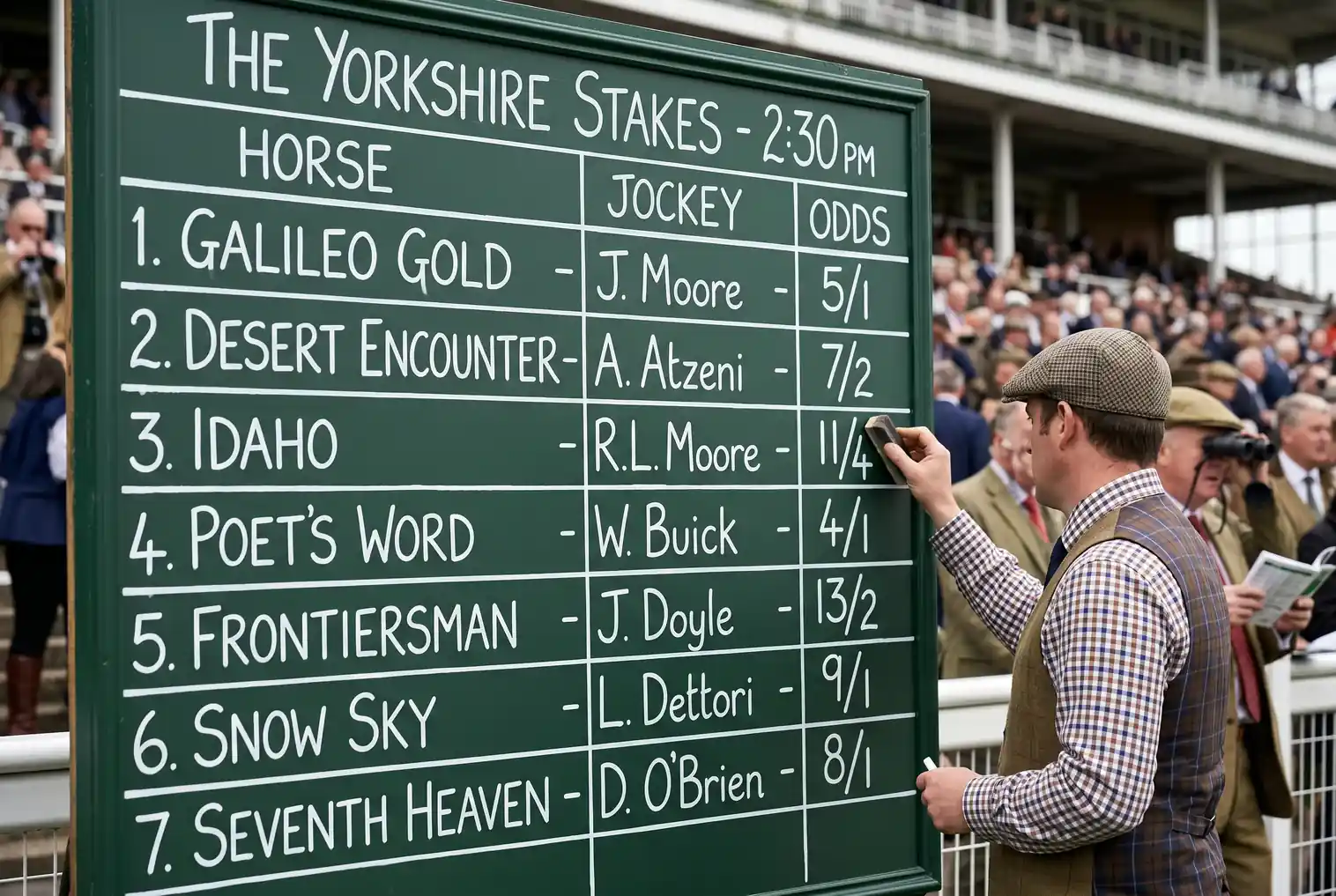
I remember the exact moment I understood odds properly. I was standing in a betting shop on a Saturday afternoon, staring at a board that said 5/1 next to a horse’s name, and I thought: “If I bet ten quid, I get fifty back plus my stake.” That arithmetic was correct. What I did not grasp was the more important question — did 5/1 represent a fair assessment of that horse’s chances, or was the bookmaker offering me a bad deal dressed up in attractive numbers?
That distinction is the entire game. Odds are not just instructions for calculating your payout. They are the bookmaker’s translation of probability into price, and that translation always includes a profit margin for the house. The UK horse racing betting market generated gross gaming yield of £766.7 million in the 2024–25 financial year. That number exists because the odds on offer are systematically skewed in the bookmaker’s favour. Understanding how that skew works — and where it occasionally creates opportunities — is the foundation of intelligent punting.
Most guides explain odds as simple maths. This one goes further. I want you to understand fractional and decimal formats, convert between them instinctively, calculate implied probability, identify the bookmaker’s overround, and recognise when a price represents genuine value rather than a large-looking number. After nine years of analysing markets almost daily, I can tell you that the punters who treat odds as mere payout instructions lose money. The ones who treat odds as probability statements — flawed, biased probability statements — give themselves a chance.
Fractional Odds: The UK Standard and How to Read Them
Walk into any British racecourse and the odds boards display prices like 4/1, 7/2, 11/4, 100/30. This is the fractional format, and it has been the standard in UK racing for centuries. The number on the left is your potential profit, the number on the right is your stake. At 4/1, every pound you risk returns four pounds in profit plus your original pound back — a total return of five pounds per pound staked.
The common prices form a familiar ladder: 1/5, 2/9, 1/4, 2/7, 1/3, 4/11, 2/5, 4/9, 1/2, 8/15, 4/7, 8/13, 4/6, 8/11, 4/5, 5/6, 10/11, evens, 11/10, 5/4, 11/8, 6/4, 13/8, 7/4, 15/8, 2/1, and then stepping up through 9/4, 5/2, 11/4, 3/1, 7/2, 4/1, 9/2, 5/1 and beyond. Bookmakers stick to these traditional increments rather than using arbitrary fractions like 3.7/1, which is why you see prices jump rather than creep.
Odds-on prices — where the number on the left is smaller than the right — confuse newcomers. At 4/6, you stake six pounds to win four pounds profit. Your total return is ten pounds, but you risked six to get there. The horse is expected to win more often than not, which is why you are paid less than your stake. Odds-on favourites at 1/2 or shorter win frequently, but backing them long-term is not a path to profit because the payout when they lose wipes out several small wins.
A useful mental shortcut: divide the left number by the right to get a multiplier. 5/2 = 2.5, meaning two and a half times your stake in profit. 11/4 = 2.75. 7/2 = 3.5. For quick in-your-head calculations at the track, this is faster than thinking through the full fraction every time. The traditional odds ladder also has a rhythm — once you know that 7/4 sits between 6/4 and 2/1, and that 15/8 is the step between 7/4 and 2/1, you can mentally place any horse on the probability spectrum without a calculator.
One thing the fractional format hides: the relationship between price and probability is not linear. The difference between 2/1 and 3/1 looks like a single step, but in probability terms it is the gap between a 33% chance and a 25% chance — eight percentage points. The difference between 10/1 and 11/1 is the gap between 9.1% and 8.3% — less than one percentage point. The longer the price, the smaller the probability difference between adjacent odds. This matters when you are assessing value at bigger prices, because a horse drifting from 10/1 to 12/1 has not changed much in the market’s estimation, even though the numbers look quite different.
Decimal Odds, Implied Probability and Quick Conversion
Betting exchanges and most European bookmakers display odds in decimal format. A horse at 5/1 fractional becomes 6.0 decimal. The decimal figure represents your total return per unit staked, including your stake. At 6.0, a ten-pound bet returns sixty pounds total — fifty profit, ten stake. At 3.5 (which is 5/2 fractional), a ten-pound bet returns thirty-five pounds.
Converting between the two formats is straightforward. Fractional to decimal: divide the left by the right and add one. So 11/4 becomes (11 / 4) + 1 = 3.75. Decimal to fractional: subtract one, then express as a fraction. 4.5 becomes 3.5, which is 7/2. For odds-on prices, the same rule applies: 4/6 fractional becomes (4 / 6) + 1 = 1.67 decimal.
The real power of decimal odds is the direct path to implied probability. Divide one by the decimal price. A horse at 4.0 decimal has an implied probability of 1 / 4.0 = 25%. A horse at 2.0 (evens) implies 50%. A horse at 1.5 (1/2 fractional) implies 66.7%. This conversion is the single most useful calculation in betting, because it lets you compare the bookmaker’s opinion of a horse’s chances with your own assessment. If you believe a horse has a 35% chance of winning and the bookmaker is offering 4.0 (implying 25%), you have a potential value bet. If the bookmaker is offering 2.5 (implying 40%), the price underestimates your assessment and there is no value.
I keep a printed conversion table next to my desk even now, after nine years. Not because I cannot do the maths — I can — but because speed matters when markets move. When a price shortens from 5.0 to 4.0, the implied probability jumps from 20% to 25%. When it drifts from 3.0 to 4.0, the implied probability drops from 33% to 25%. Those shifts tell you what the market is thinking in real time, and grasping them instantly rather than pausing to calculate gives you an edge in fast-moving situations.
Decimal odds also expose the awkwardness of certain fractional prices. The difference between 9/4 (3.25 decimal) and 5/2 (3.50 decimal) is only 0.25 in decimal terms, but the fractional formats look quite dissimilar. Seeing both formats simultaneously trains your eye to evaluate prices more accurately, which is why I recommend anyone serious about value betting in horse racing to work in decimals for analysis, even if you place your bets using fractional odds.
Recommended online casinos
- BeOnBetBonus: 100% up to €500 + 100 FS · Payout speed: 1-3 business days
- Revery PlayBonus: 100% up to€1,000+ 100 FS · Payout speed: 1-3 business days
- ChanzeBonus: Slots Welcome Bonus #1 200% up to €500 · Payout speed: 1-3 business days
- JetsetspinsBonus: 200% Bonus + 100 Free Spins + Free Royal Wheel · Payout speed: 1-3 business days
- DieselwinBonus: Welcome Pack 250% up to £4000 + 200 FS · Payout speed: 1-3 business days
- ZombillionBonus: Welcome Pack 250% up to £4000 + 200 FS · Payout speed: 1-3 business days
- WinBeastBonus: €5000 + 500 FS + €650 Freebet · Payout speed: 1-3 business days
- NightWinBonus: £900 + 400 free spins · Payout speed: 1-3 business days
- SpinFormulaBonus: 550% Up To £15,000 + 550 FS · Payout speed: 1-3 business days
The Overround: How Bookmakers Build Their Margin into Every Race
Here is a thought experiment that changed how I see betting markets. Imagine a two-horse race where both runners have a genuine 50% chance of winning. Fair odds would be evens (2.0 decimal) on both. If you bet ten pounds on either at 2.0, your expected return is exactly ten pounds — no profit, no loss over time. The bookmaker, obviously, cannot operate like this. So instead of offering 2.0 on both, the bookmaker offers 10/11 (1.91) on each. The implied probabilities now add up to 52.4% + 52.4% = 104.8%. That extra 4.8% above 100% is the overround — the bookmaker’s built-in margin.
In real UK racing markets, the overround varies by race type, field size, and betting interest. A competitive six-runner Group 1 race might carry an overround of 110–115%. A twenty-runner handicap at a minor Monday meeting might push 130% or higher. Total remote betting gross gaming yield in the UK hit £2.6 billion for 2024–25, and the overround is the mechanism that makes that possible. Every percentage point above 100% in the book is a percentage point of edge the bookmaker holds over the collective punting population.
Calculating the overround is simple: convert each horse’s fractional odds to implied probability, then sum all the probabilities. If a four-runner race has horses priced at 2/1, 5/2, 4/1 and 6/1, the implied probabilities are 33.3%, 28.6%, 20.0% and 14.3%, totalling 96.2%. Wait — that is below 100%? No. I deliberately chose unrealistic prices to make a point. Real bookmaker prices would be shorter across the board. Adjusted to realistic market prices of, say, 7/4, 2/1, 7/2 and 5/1, the sum becomes 36.4% + 33.3% + 22.2% + 16.7% = 108.6%. That 8.6% overround is the tax you pay, as a punter, for the privilege of betting.
Researchers studying Betfair exchange data found a remarkably high level of informational efficiency in exchange returns, contrasting with the heavier tails and volatility clustering seen in financial markets. Exchange markets typically run much tighter overrounds — often 101–103% — because they match punter against punter rather than punter against bookmaker. The lower the overround, the closer to a “fair” market, and the less you need to overcome to be profitable. This is one reason serious value bettors gravitate towards exchanges for certain types of bet.
I check the overround before every bet. If a race book exceeds 125%, I know the margin stacked against me is severe, and only a horse I rate as a strong overlay is worth backing. If the book is 110%, the pricing is more generous, and a moderate edge in my probability assessment might be enough. The overround is not just a theoretical concept — it is a practical filter that tells you how hard each race is to beat.
Starting Price vs Early Price vs Best Odds Guaranteed
Three years ago I started logging whether I would have been better off taking the early price or waiting for SP on every bet I placed. After twelve months and around 600 bets, the answer was clear: early prices won by a margin of roughly 4% in terms of average odds obtained. That is not a universal truth — it depends on the type of horse and the type of race — but it matched the broader industry pattern.
The Starting Price, or SP, is the official price returned on a horse at the moment the race begins. It is determined by on-course bookmakers and represents the final state of the betting market. If you do not take a fixed price, your bet settles at SP. The problem with SP is that it reflects all the late money, including informed money from connections and professionals who bet close to the off. If a horse attracts a rush of support in the final minutes, its SP will be shorter than the price available that morning.
Early prices — sometimes called “overnight prices” or “morning prices” — are the odds bookmakers publish the evening before or the morning of a race. These prices are the bookmaker’s opening assessment, and they move throughout the day as money comes in. Taking an early price locks in that number. If the horse subsequently shortens from 8/1 to 5/1 by the off, you still get 8/1. If it drifts from 8/1 to 12/1, you are stuck at 8/1.
Best Odds Guaranteed, commonly abbreviated to BOG, is the market’s answer to that asymmetry. Most major UK bookmakers offer BOG on horse racing, which means if you take an early price and the SP is higher, you get paid at the SP instead. It is a free upgrade — you lock in the early price as a floor, and if the market moves in your favour, you benefit. Average turnover on Core Fixtures fell 8.6% against 2024, while Premier Fixtures saw a 2.7% rise — a pattern that partly reflects where informed money concentrates. BOG matters most on the core everyday cards where prices can shift significantly.
My general approach: take the early price on horses I expect to shorten (well-fancied runners from top yards, horses with obvious form claims) and wait for SP only on horses I think might drift (unexposed types, runners returning from absence, runners in races where the form is messy and the market might overreact to late information). BOG eliminates most of the downside of taking early prices, so the default position should be to take the price when you see value rather than hoping it gets better.
What Market Moves Tell You About a Horse’s Chances
A horse opens at 12/1 in the morning and is 6/1 by the time the race starts. Something has happened. Money has arrived — serious money, in volume — and the bookmakers have cut the price to manage their liability. The question every punter should ask is not “should I follow the money?” but “what kind of money is it?”
Market moves come from different sources. Stable money — bets placed by or on behalf of the horse’s connections — tends to be well-informed. Connections know how their horse has been working at home, whether it is fit, whether the ground suits, whether the jockey is confident. When a horse shortens dramatically and the move coincides with a trainer or jockey who has a strong record when their runners shorten, that is a signal worth respecting. Tipster-driven moves are noisier. A popular newspaper tipster putting up a 10/1 shot can cause a wave of bets that shortens the price without any new private information entering the market.
Betfair exchange data from a study of 73 markets showed over a million price signals, with new bets arriving roughly every 50 seconds. That volume of activity means exchange prices respond very quickly to information. A horse shortening on the exchanges from 10.0 to 7.0 in the final ten minutes before a race is a sharper signal than the same move over three hours, because the late money tends to come from more informed sources.
Drifters — horses whose price lengthens during the day — are also informative. A drift from 5/1 to 8/1 suggests that money expected to arrive has not materialised, or that negative information has entered the market. Perhaps the horse was reported to have had a disappointing piece of work, or a rival has attracted all the support. Drifters have a lower win rate than their starting position would suggest, which makes intuitive sense: the market is telling you something, and ignoring it costs money over time.
I use market moves as a confirmation tool rather than a primary signal. If my form analysis has shortlisted a horse and its price subsequently shortens, the market is agreeing with my assessment, which increases my confidence. If my selection drifts badly, I re-examine my reasoning. The move does not automatically change my mind, but it forces me to ask whether I have missed something. Treating market moves this way — as a dialogue between your analysis and the collective intelligence of the market — is far more productive than blindly following or ignoring the money.
Comparing Odds Across Bookmakers: A Practical Approach
The UK betting market operates with 499 licensed operators, and no two of them offer identical prices on every race. That variation is your opportunity. The difference between getting 7/2 and 4/1 on the same horse is the difference between a £35 return and a £40 return on a tenner — and over hundreds of bets, those margins compound into a significant impact on your bottom line.
Odds comparison sites show prices from multiple bookmakers side by side. I check them before placing any bet, and the process takes about thirty seconds. The goal is not to find the theoretical best price on every horse in every race — that level of optimisation is impractical — but to make sure you are not consistently taking the worst price in the market. If three bookmakers offer 5/1 and one offers 4/1 on the same horse, taking the 4/1 is a 20% reduction in your potential profit for no reason.
The variation is typically largest on less popular races — midweek meetings, evening all-weather cards, low-grade handicaps. On high-profile races like the Gold Cup or the Derby, prices converge because the volume of money forces all bookmakers towards a similar position. This means odds shopping delivers the most value on the everyday bread-and-butter races where most regular punters place the majority of their bets.
Having accounts with several bookmakers is not just about comparison — it also gives you flexibility. Some bookmakers are more generous on certain race types. Some are slower to adjust prices after morning market moves. Some offer better each-way terms on specific races. Over time, you develop a sense of which bookmaker is likely to offer the best price in different scenarios, and you route your bets accordingly. This is not sharp practice — it is basic consumer behaviour applied to betting.
Common Odds Traps and How to Sidestep Them
The most expensive trap in horse racing odds is what I call “big number blindness.” A horse at 25/1 looks exciting. If it wins, the return is transformational. But 25/1 implies a 3.8% chance — roughly one win in every 26 runs. Unless you genuinely believe the horse has a better chance than 3.8%, you are paying a premium for excitement, not making a sound bet. The long-term return from blindly following the favourite in every race is roughly a 7% loss on turnover. Backing longshots without a disciplined value framework produces far worse results, because the overround is proportionally larger at the bottom of the market.
The second trap is anchoring. If a horse was 8/1 yesterday and is now 6/1, many punters feel they have “missed the value.” But the question is not what the price was — it is what the price should be. If 6/1 still represents an overlay relative to the horse’s true probability, it is still a value bet. If 8/1 was overpriced to begin with (the market was wrong, and the correction to 6/1 was justified), then 8/1 was never real value — it was a mispriced number that you happened to see before the correction.
A third trap is confusing the odds format with the payout. Some bookmakers display decimal odds by default on their websites while their in-shop boards show fractional. A horse at 4.0 decimal is 3/1 fractional — exactly the same price. I have seen punters think they were getting a better deal on one platform than another simply because the numbers looked different. Get comfortable converting between formats, and you will never fall for this.
The final trap is ignoring the overround when assessing a price in isolation. A horse at 5/1 in a race with a 110% book is a different proposition from a horse at 5/1 in a race with a 130% book. In the first case, 5/1 implies roughly 18.2% in real probability terms (after adjusting for the overround). In the second, the raw 5/1 is more heavily distorted. The headline price might be identical, but the underlying value is not. Adjusting for the overround is not optional — it is the difference between assessing odds and assessing real probability.
Frequently Asked Questions
Why do different bookmakers offer different odds on the same horse?
Each bookmaker sets their own prices based on their risk exposure, customer betting patterns, and market position. They balance the book independently, which means one bookmaker might attract more money on a particular horse and shorten its price while another still has it at a longer price. The differences are usually small on high-profile races but can be significant on everyday cards.
What does ‘best odds guaranteed’ actually guarantee?
Best odds guaranteed means that if you take a fixed price on a horse and the starting price turns out to be higher, you get paid at the higher SP instead. It protects you against the downside of taking an early price that subsequently drifts. Most major UK bookmakers offer this on horse racing, but terms vary — some limit it to races in Britain and Ireland, and maximum payout caps may apply.
How do I convert fractional odds to implied probability quickly?
Add the two numbers in the fraction together, then divide the right-hand number by that total. For 5/1: 5 + 1 = 6, then 1 / 6 = 16.7%. For 7/4: 7 + 4 = 11, then 4 / 11 = 36.4%. This gives you the bookmaker’s implied probability before adjusting for the overround. To get closer to the true probability, you would need to remove the overround, but the raw implied probability is a useful quick reference.
Should I always take the early price or wait for SP?
There is no universal rule. Early prices tend to offer better value on horses that are well-fancied and likely to shorten, while SP can be better on drifters or uncertain runners. If best odds guaranteed is available, taking the early price carries less risk because you are protected against an SP drift in your favour. As a general default, take the price when you see value rather than hoping it improves.
The full picture is in our data-driven guide to horse racing betting.
Turning a price into an edge: value betting.
Written by the editors at Tips for Horse Racing Betting.