Lay Betting Explained: How to Profit by Opposing Horses on a Betting Exchange
Best Horse Racing Betting Sites – Bet on Horse Racing in 2026
 Available in US
Table of Contents
- Backing Losers on Purpose — Why Lay Betting Turns Horse Racing on Its Head
- Recommended online casinos
- How a Lay Bet Works: Stake, Liability and Payout
- When Laying Makes Sense: Overbet Favourites and Vulnerable Market Leaders
- Managing Lay Liability: Setting Limits and Using Stop Losses
- Three Lay Strategies for Different Experience Levels
Backing Losers on Purpose — Why Lay Betting Turns Horse Racing on Its Head
The first time someone explained lay betting to me, I thought they were joking. “So I bet against a horse? I want it to lose?” Exactly. And once that mental shift clicks, an entirely new dimension of horse racing betting opens up. Favourites in UK racing win roughly 30-35% of the time, which means they lose 65-70% of the time. Laying is about positioning yourself on the side of probability that most punters ignore.
Traditional backing asks: which horse will win? Laying asks the opposite: which horse will not win? And that second question is often easier to answer. A horse with dodgy ground preferences, a jockey booking that signals a training exercise rather than a serious attempt, or a form profile that flatters on paper but falls apart under scrutiny — these are lay candidates. You do not need to know who will win. You just need to identify who probably will not.
Recommended online casinos
- BeOnBetBonus: 100% up to €500 + 100 FS · Payout speed: 1-3 business days
- Revery PlayBonus: 100% up to€1,000+ 100 FS · Payout speed: 1-3 business days
- ChanzeBonus: Slots Welcome Bonus #1 200% up to €500 · Payout speed: 1-3 business days
- JetsetspinsBonus: 200% Bonus + 100 Free Spins + Free Royal Wheel · Payout speed: 1-3 business days
- DieselwinBonus: Welcome Pack 250% up to £4000 + 200 FS · Payout speed: 1-3 business days
- ZombillionBonus: Welcome Pack 250% up to £4000 + 200 FS · Payout speed: 1-3 business days
- WinBeastBonus: €5000 + 500 FS + €650 Freebet · Payout speed: 1-3 business days
- NightWinBonus: £900 + 400 free spins · Payout speed: 1-3 business days
- SpinFormulaBonus: 550% Up To £15,000 + 550 FS · Payout speed: 1-3 business days
How a Lay Bet Works: Stake, Liability and Payout
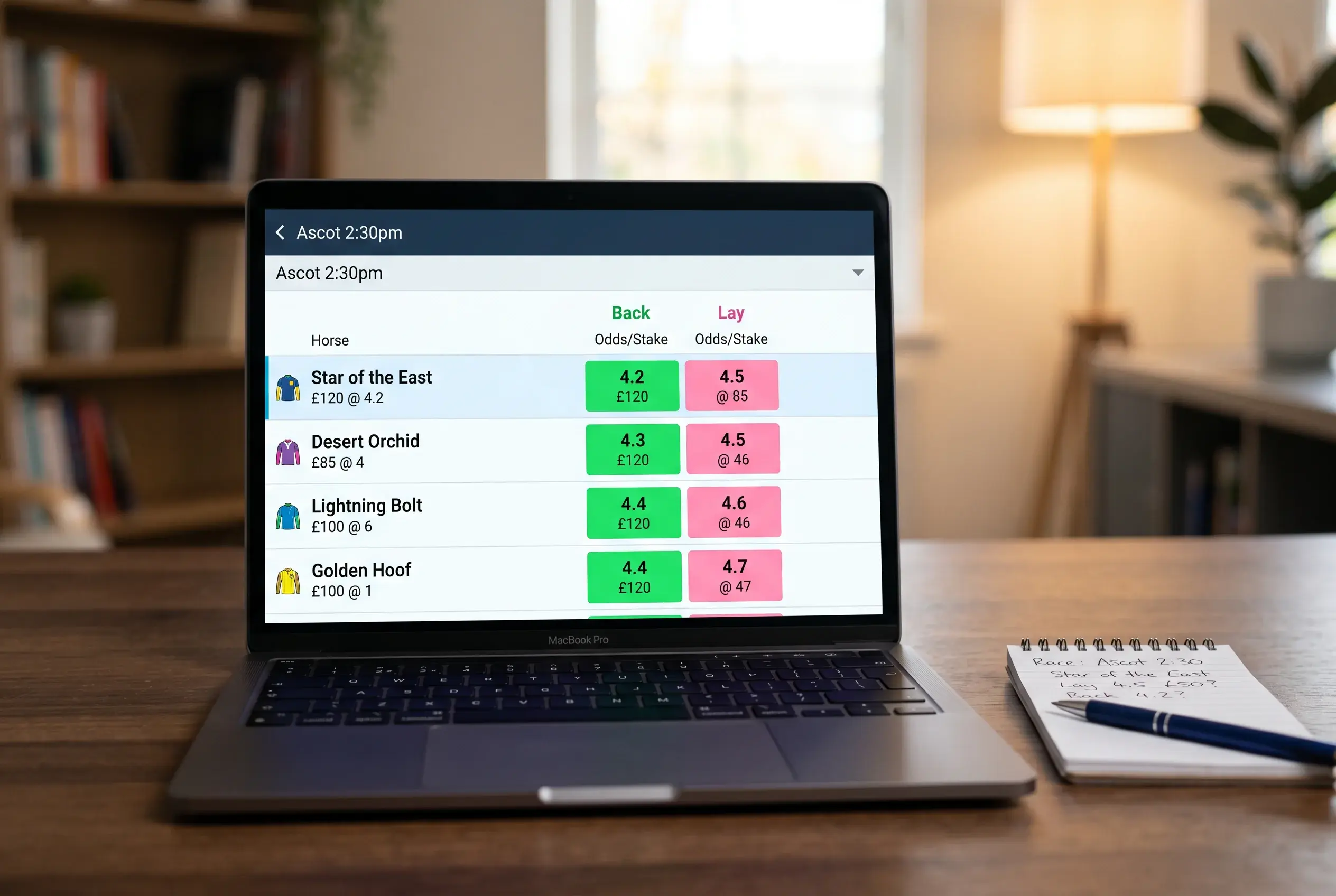
When you lay a horse on a betting exchange, you are acting as the bookmaker. Another punter wants to back that horse, and you are offering the other side of the bet. If the horse loses, you keep their stake (minus the exchange commission). If the horse wins, you pay out at the agreed odds.
The terminology trips people up, so let me use concrete numbers. You lay a horse at 4.0 (3/1 in fractional) for £10. The backer’s £10 is their risk. Your risk — called liability — is the potential payout minus the backer’s stake: (4.0 – 1) x £10 = £30. If the horse loses, you collect £10 (minus commission, typically 2-5%). If the horse wins, you lose £30. Your maximum loss is always the liability, and you can see that figure before confirming the bet.
The relationship between odds and liability is crucial. Laying at 2.0 (even money) means your liability equals the backer’s stake — £10 risk for £10 potential profit. Laying at 10.0 means your liability is nine times the backer’s stake. This is why experienced layers concentrate on shorter-priced horses: the liability is manageable, and the probability of the horse losing is lower at shorter odds. Laying a 20/1 outsider might seem tempting because it is “likely to lose,” but the liability is enormous relative to the small profit, and one unlucky winner wipes out dozens of winning lays.
When Laying Makes Sense: Overbet Favourites and Vulnerable Market Leaders
I had a spell in 2022 where I laid every odds-on favourite that met three specific criteria: first run after a layoff of 60 days or more, step up in class, and a jockey booking that was not the trainer’s primary rider. Over 87 qualifying bets, the strike rate of those favourites was 41% — lower than the expected 55-60% for odds-on shots on the flat. The profit on lay stakes was modest but consistent.
Odds-on favourites win 55-60% of their races in UK flat racing. That sounds like a losing proposition for layers, but the maths is more nuanced. At odds of 1.5 (1/2), a 60% win rate for the favourite means you lose 60% of the time (paying out £5 liability per £10 backer stake) and win 40% of the time (collecting £10). Net result over 100 bets: 60 losses of £5 = £300 lost, 40 wins of £10 = £400 gained, gross profit of £100 before commission. The edge is thin but real, and it improves significantly when you can filter out the genuinely vulnerable favourites from the rock-solid ones.
The richest lay opportunities sit in races where public money has inflated a horse’s price beyond its true ability. Big-race days and televised meetings attract casual punters who back names, connections or recent headlines rather than form. That extra weight of public money shortens the price, creating a false favourite — a horse that is favoured by the market but not by the evidence.
Managing Lay Liability: Setting Limits and Using Stop Losses
Liability management is the discipline that separates sustainable layers from blown accounts. I set a hard ceiling: my maximum liability on any single lay bet is 5% of my betting bank. If my bank is £1,000, no lay bet can carry more than £50 in potential loss. That rule has never changed in nine years of exchange trading.
The 5% ceiling forces a natural selection process. If a horse is priced at 6.0, laying it for a £10 backer stake creates a £50 liability — right at my limit on a £1,000 bank. At 8.0, the same backer stake creates £70 liability, which exceeds the limit, so I either reduce the stake or walk away. This mechanical constraint keeps me out of the high-liability territory where one bad result can undo weeks of careful work.
Stop losses are simpler on exchanges than most punters realise. If you lay a horse pre-race and the price shortens (meaning the market disagrees with your view), you can back the horse at the shorter price to lock in a defined loss. Say you laid at 4.0 and the price drops to 3.0 before the off. Backing at 3.0 caps your worst-case scenario at a known figure, regardless of the race result. It is the exchange equivalent of cutting a losing trade in the stock market, and it is a tool I use at least once a week.
Three Lay Strategies for Different Experience Levels
For beginners, start with “lay the odds-on drifter.” Identify odds-on favourites whose price has lengthened in the final 15 minutes of pre-race trading. A horse that opens at 4/5 and drifts to evens is attracting less sharp money than the market initially expected. Lay at evens, liability equals stake, and you have a roughly 45% chance of collecting. It is a slow grind, but it teaches the mechanics without exposing you to heavy liability.
Intermediate layers can move to “lay the class dropper.” Horses dropping in class are automatic favourites with the public, but the reasons for the class drop — poor recent form, a wind operation, a trainer trying to restore confidence — often mean the horse is not the certainty the price implies. Filter for horses dropping two or more classes with form figures that include a recent finishing position of fifth or worse. The lay strike rate on these tends to run 55-65% in my experience.
Advanced layers trade in-play. This requires live streaming, quick execution and the nerve to lay a horse whose price is collapsing as the race unfolds because you have read the pace scenario and believe the leader is going too fast to sustain. In-play laying is not for everyone — the decision window is measured in seconds, and the emotional intensity is significantly higher than pre-race betting. But the edge can be substantial for punters who can read a race in real time.
What is the maximum I can lose on a lay bet?
Your maximum loss is the liability, which equals the backer’s stake multiplied by (the lay odds minus 1). For example, laying a £10 stake at odds of 5.0 creates a £40 liability. This amount is held by the exchange when you place the bet, so you always know your worst-case scenario before confirming.
Can I lay a horse in-play on Betfair?
Yes. Betfair and other exchanges allow in-play lay bets on horse racing. Prices update continuously as the race progresses. In-play laying carries additional risk from latency (the delay between your screen and the exchange server), so the price you request may not be the price you receive. Many experienced layers use automatic tools to manage this delay.
Why would I lay a horse instead of just backing another one?
Laying lets you profit from identifying likely losers rather than likely winners. In races with wide-open fields, pinpointing the horse that will not win can be easier than choosing the winner. Laying also offers a hedge tool: if you have backed a horse and the price shortens, you can lay it at the shorter price to lock in profit regardless of the result.
The full picture is in our data-driven guide to horse racing betting.
Where laying happens: the exchange compared.
Created by the ”Tips for Horse Racing Betting” editorial team.