Is Horse Racing Betting Profitable? What the Data Says About Long-Term Returns
Best Horse Racing Betting Sites – Bet on Horse Racing in 2026
 Available in US
Table of Contents
- Blindly Backing Every Favourite Loses About 7% of Your Stake — but Not Everyone Bets Blindly
- What Profitable Looks Like: ROI Benchmarks for Recreational and Serious Punters
- Recommended online casinos
- What Profitable Punters Do Differently: Five Patterns from the Data
- Hidden Costs: Overround, Commission, Withdrawal Fees and Opportunity Cost
- Setting Realistic Expectations: Monthly, Quarterly and Annual Variance

Blindly Backing Every Favourite Loses About 7% of Your Stake — but Not Everyone Bets Blindly
Every punter I know has asked themselves the same question, usually after a bad month: is this even possible? Can you actually make money from horse racing? The answer is yes — but with qualifications that most people do not want to hear. Systematic betting on favourites over the long term returns roughly 93p for every pound staked. That is a 7% loss, which is the market’s built-in cost — the overround, the bookmaker’s margin. If you bet randomly, you lose. The question is whether you can do better than random, and by how much.
I have been tracking my own results since 2017. In nine years, I have had four profitable calendar years, three break-even years and two losing years. My overall ROI sits at 4.6%, which sounds modest until you calculate the cumulative effect over thousands of bets. That is not a get-rich number. It is a “keep-betting-and-the-bank-grows” number. And it has only been possible because I treat betting as a disciplined process, not a recreational gamble.
What Profitable Looks Like: ROI Benchmarks for Recreational and Serious Punters
A recreational punter who breaks even — returning 100p for every pound staked — is already beating the market’s built-in loss. This sounds unambitious, but it means you are enjoying the sport, maintaining your bank, and not subsidising the bookmaker beyond the entertainment value. An ROI of 0% to 3% is a realistic target for a disciplined recreational punter who specialises in a niche (flat sprints, jumps handicaps, a specific course) and applies basic form analysis and value principles.
A serious punter with a systematic approach might target 3-8% ROI over a year. At this level, variance is your constant companion — a bad month can drop you to -10% before a strong quarter pulls you back. The remote betting sector generated £2.6 billion in gross gambling yield in 2024-25, and the vast majority of that comes from punters who do not achieve positive ROI. The minority who do tend to share specific habits that I will cover shortly.
Professional-level ROI above 8% is rare and usually associated with punters who trade on exchanges, exploit specific market inefficiencies, or operate at volumes that amplify small edges. If someone claims a 20% ROI over a large sample, ask for the verified track record. Claims like that are far more common than the reality.
Recommended online casinos
- BeOnBetBonus: 100% up to €500 + 100 FS · Payout speed: 1-3 business days
- Revery PlayBonus: 100% up to€1,000+ 100 FS · Payout speed: 1-3 business days
- ChanzeBonus: Slots Welcome Bonus #1 200% up to €500 · Payout speed: 1-3 business days
- JetsetspinsBonus: 200% Bonus + 100 Free Spins + Free Royal Wheel · Payout speed: 1-3 business days
- DieselwinBonus: Welcome Pack 250% up to £4000 + 200 FS · Payout speed: 1-3 business days
- ZombillionBonus: Welcome Pack 250% up to £4000 + 200 FS · Payout speed: 1-3 business days
- WinBeastBonus: €5000 + 500 FS + €650 Freebet · Payout speed: 1-3 business days
- NightWinBonus: £900 + 400 free spins · Payout speed: 1-3 business days
- SpinFormulaBonus: 550% Up To £15,000 + 550 FS · Payout speed: 1-3 business days
What Profitable Punters Do Differently: Five Patterns from the Data
After nine years of tracking my own results and comparing notes with other profitable punters, five patterns emerge consistently. About 80% of races are won by the top 20% of trainers and jockeys, and profitable punters exploit this concentration rather than fighting it.
They specialise. Every profitable punter I know focuses on a subset of racing: a specific code (flat or jumps), a distance range, a group of courses, or a race type (handicaps, novices, Group races). Specialisation narrows the dataset you need to master and lets you spot patterns that generalists miss. My own best results come from flat handicaps at seven courses where I have deep draw and going data stretching back years.
They price every race before checking the market. Building a tissue — your own estimated probability for each runner — before looking at the bookmaker’s odds prevents anchoring to the market price. If your tissue says a horse is a 3/1 chance and the market offers 5/1, that is a value bet. If the market offers 2/1, you pass. The Jockey Club’s chief executive has expressed concern that regulators seem to want to reduce gambling to small-stakes activity, but for profitable punters, the ability to stake meaningfully on genuine value is what makes the process work.
They track everything. Every bet, every selection rationale, every result. The spreadsheet is the most underrated tool in horse racing. Without data, you cannot identify which types of bet, which courses, which conditions produce your best results. I review my records quarterly, and each review has led to at least one adjustment that improved the following quarter’s performance.
They manage their bank ruthlessly. Profitable punters never bet more than they can afford to lose on a single race, never chase losses, and never increase stakes because they “feel” confident. The systematic approach to staking and strategy is what keeps them in the game long enough for edge to compound.
They accept losing periods as inevitable. A 20-bet losing run is statistically normal at a 25% strike rate. Profitable punters know this, plan for it, and do not change their process because of it. Unprofitable punters panic, switch strategies, increase stakes and blow their banks. The difference is not talent — it is temperament.
Hidden Costs: Overround, Commission, Withdrawal Fees and Opportunity Cost
The overround is the most visible cost, but it is not the only one. Exchange commission (typically 2-5% of net winnings) reduces your gross profit on every winning bet. Withdrawal fees vary by operator — some charge for bank transfers, others for card withdrawals. Individually these costs are small, but they compound.
Opportunity cost is the cost nobody talks about. The time spent on form analysis, market monitoring, record keeping and strategy review is substantial. If you spend 10 hours a week on horse racing betting and generate a modest £50 profit, your effective hourly rate is £5. For some people, that is fine — the process itself is enjoyable. For others, the honest answer to “is it profitable?” might be “yes, but not relative to the time invested.”
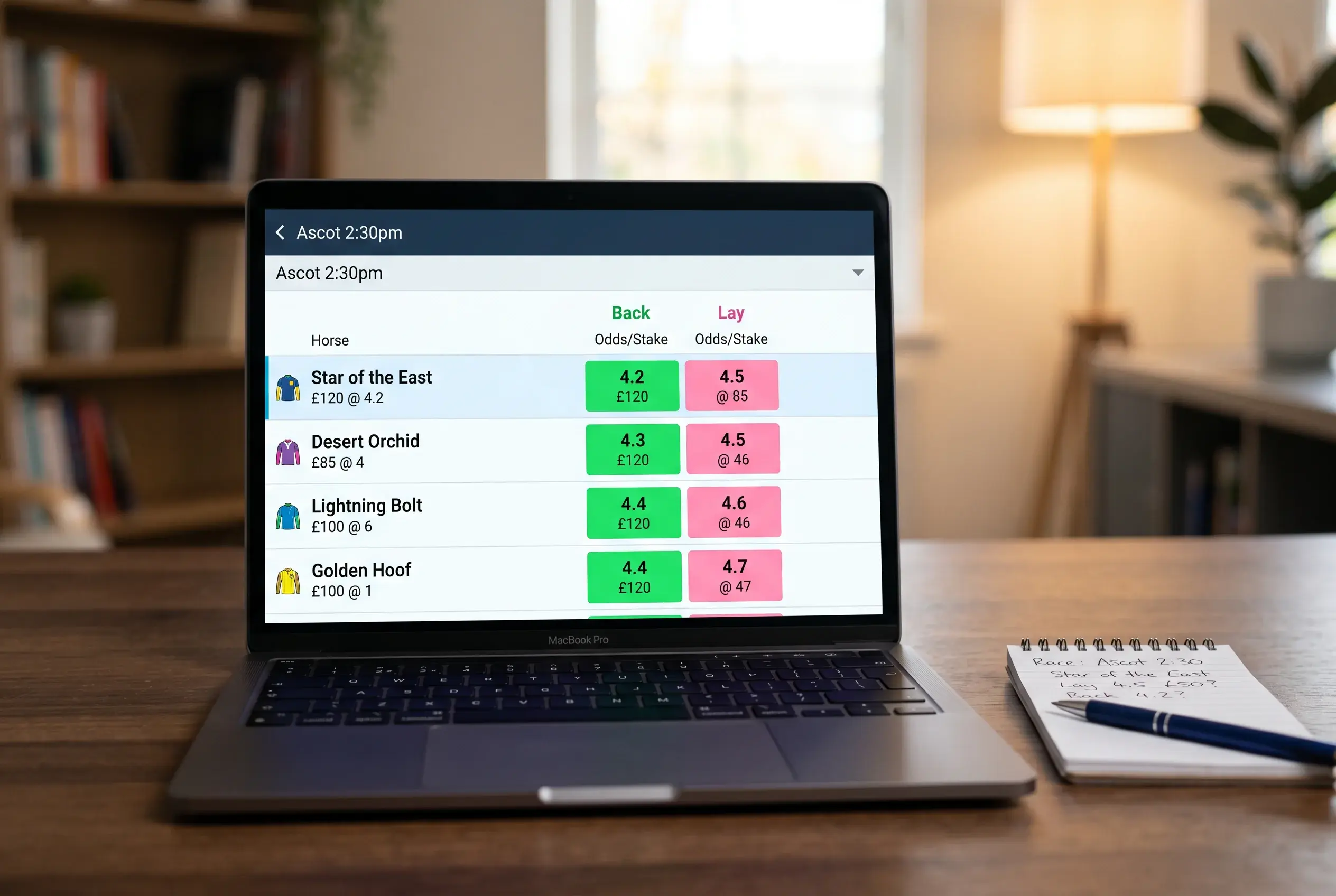
Account restrictions are a hidden cost specific to profitable punters. Bookmakers who identify consistently winning customers may limit stakes or close accounts. This forces profitable punters onto exchanges, where the prices are typically better but the commission reduces margins. The exchange model is structurally fairer — it does not penalise winners — but the commission drag means your gross edge needs to be larger to produce the same net profit.
Setting Realistic Expectations: Monthly, Quarterly and Annual Variance
Variance is the gap between what should happen and what actually happens over a specific period. In horse racing, variance is brutal over short periods and smooths out over long ones. Horse racing betting participation swings between 4% and 7% of the UK population depending on the season, and your results will show similar swings — strong during the festivals and feature weekends, quiet during low-quality midweek cards.
In a typical month of 40-60 bets, a profitable punter with a 5% long-term ROI might see monthly results ranging from -20% to +30%. That is normal. It does not mean the strategy is broken when the month ends negative. Over a quarter (120-180 bets), the range tightens to roughly -10% to +20%. Over a full year (500+ bets), the expectation is that the positive edge begins to dominate and the result converges towards the true ROI.
If you cannot tolerate three consecutive losing months without changing your approach, horse racing betting may be the wrong pursuit. The edge is real but small, and it takes patience, discipline and a large enough sample of bets for it to become visible in your results. The punters who profit long-term are the ones who trust the process through the dry spells.
What ROI should I aim for as a recreational horse racing bettor?
Breaking even (0% ROI) is a realistic and respectable first target. If you can consistently return your stakes over 500+ bets, you are outperforming the majority of punters. An ROI of 2-5% is achievable for disciplined recreational bettors who specialise and apply value principles. Anything above 5% puts you in serious punter territory.
How many bets per month does a profitable punter typically place?
Most profitable punters I know place 30-80 bets per month, though the range varies by specialism. Quality matters more than quantity — forcing bets to hit a target number defeats the purpose. If your analysis produces 15 qualified selections in a month, bet 15. If it produces 60, bet 60. The process should determine the volume, not the other way round.
Do bookmakers close accounts of consistently winning customers?
Yes. Major UK bookmakers routinely limit stakes or close accounts of customers who show a sustained profit. This is not illegal — bookmakers have the right to manage their customer base — but it is frustrating for profitable punters. The practical consequence is that consistently winning bettors tend to migrate to exchanges, where winners are welcomed because the platform profits from commission regardless of outcomes.
The full picture is in our data-driven guide to horse racing betting.
What profitability actually requires: value betting.
Prepared by the Tips for Horse Racing Betting editorial staff.