Royal Ascot Betting Guide: How Form, Pace and Conditions Shape the Summer’s Biggest Meeting
Best Horse Racing Betting Sites – Bet on Horse Racing in 2026
 Available in US
Table of Contents
- Five Days, Thirty Races and the Strongest Fields of the Flat Season
- Track Layout and Draw Impact on Ascot’s Two Courses
- Recommended online casinos
- Class Standards and Form Lines That Transfer to Ascot
- Big Handicaps vs Group Races: Different Analytical Priorities
- Summer Going: How Firm Ground and Rain Alerts Shape the Week
Five Days, Thirty Races and the Strongest Fields of the Flat Season
I remember standing in the Silver Ring at Ascot on a Tuesday afternoon, watching an eight-runner Queen Anne Stakes where every single horse had Group 1 form. That depth of field is what makes Royal Ascot unique — and what makes it both thrilling and unforgiving for punters. With 4.8 million people attending British racecourses each year and attendance still climbing, the Royal meeting draws the biggest concentration of quality across any single week on the Flat calendar.
Across five days in June, roughly thirty races unfold on two distinct track configurations. The quality ranges from the highest Group 1 contests, where international raiders meet British champions, to ultra-competitive heritage handicaps where 20-plus runners create open, chaotic markets. For anyone serious about betting this meeting, preparation starts weeks earlier — and it starts with understanding how Ascot’s track layout, class standards and summer conditions shape every result.
Track Layout and Draw Impact on Ascot’s Two Courses
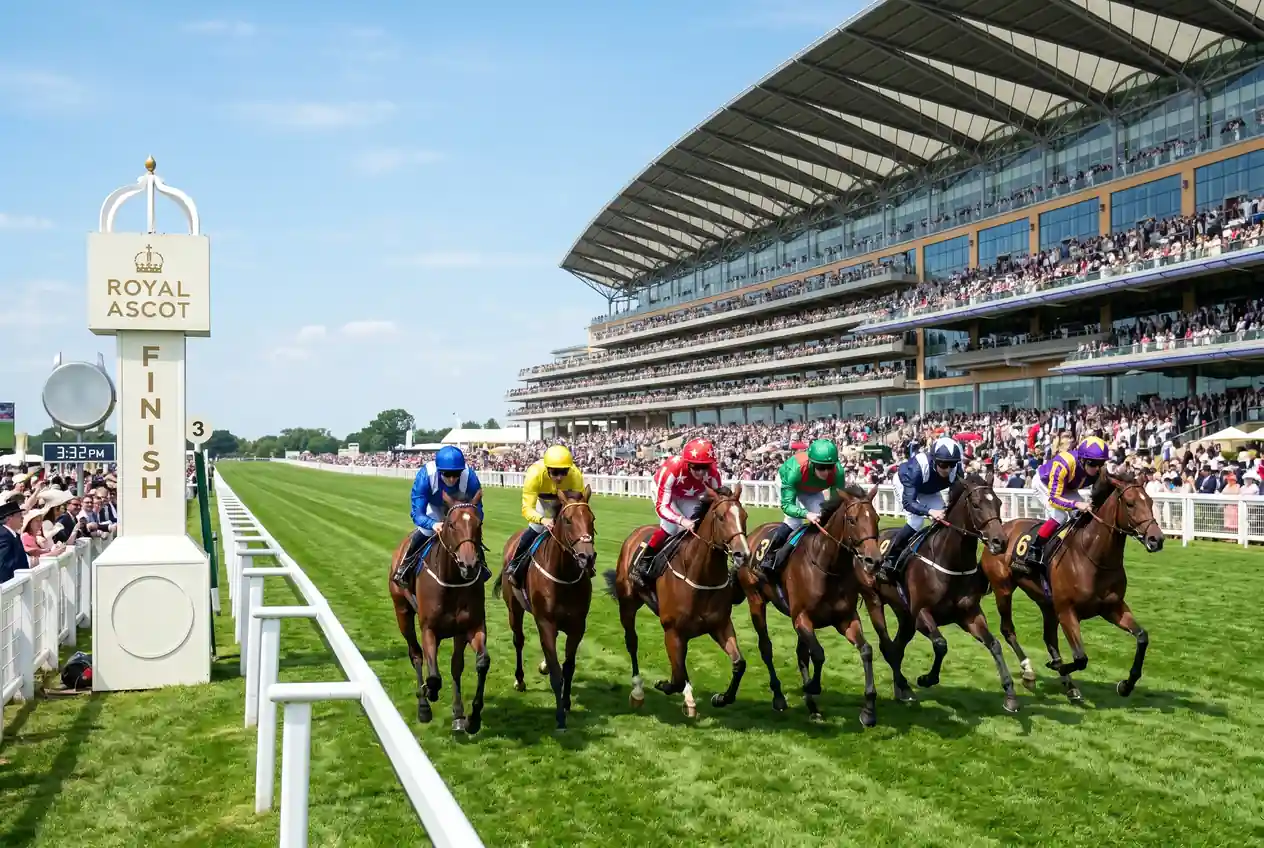
Have you ever noticed how two races on the same afternoon at Ascot can feel like they were run at entirely different venues? That is because they effectively were. Ascot operates two courses: a round course with a sweeping right-hand turn for races from a mile upwards, and a straight course for sprints up to seven furlongs. Your approach to each needs to be different.
The straight course runs slightly uphill for the first half, dips through a shallow valley, then climbs again to the finishing post. In big-field sprints — the Wokingham, the King’s Stand — draw bias on the straight course becomes a genuine factor. When the ground rides fast and the field is large, high draws tend to cluster on the far side, and whichever group finds the better strip of ground often dominates. I have seen years where the entire first four home came from stalls 15 and above, and other years where the stands’ rail proved golden. The variable is going: on genuinely good to firm, the bias shifts; after overnight rain, the lower-numbered stalls suddenly get an edge.
The round course suits horses that handle an undulating track and can sustain a long run for home. The final three furlongs rise steadily, which punishes front-runners without true stamina. In the Gold Cup and the longer Group races, pace and fitness matter more than raw speed, and a horse that travelled smoothly through the middle of the field at Newbury can look like a different animal on Ascot’s final climb.
Recommended online casinos
- BeOnBetBonus: 100% up to €500 + 100 FS · Payout speed: 1-3 business days
- Revery PlayBonus: 100% up to€1,000+ 100 FS · Payout speed: 1-3 business days
- ChanzeBonus: Slots Welcome Bonus #1 200% up to €500 · Payout speed: 1-3 business days
- JetsetspinsBonus: 200% Bonus + 100 Free Spins + Free Royal Wheel · Payout speed: 1-3 business days
- DieselwinBonus: Welcome Pack 250% up to £4000 + 200 FS · Payout speed: 1-3 business days
- ZombillionBonus: Welcome Pack 250% up to £4000 + 200 FS · Payout speed: 1-3 business days
- WinBeastBonus: €5000 + 500 FS + €650 Freebet · Payout speed: 1-3 business days
- NightWinBonus: £900 + 400 free spins · Payout speed: 1-3 business days
- SpinFormulaBonus: 550% Up To £15,000 + 550 FS · Payout speed: 1-3 business days
Class Standards and Form Lines That Transfer to Ascot
A few years ago I backed a horse that had won a Listed race at Newmarket by four lengths, only to watch it finish stone last in a Group 2 at Ascot. The class jump looked manageable on paper. It was not. Around 80% of all UK races are won by the top 20% of trainers and jockeys at each course, and at Royal Ascot that concentration tightens even further. This meeting is dominated by a handful of super-stables: the Coolmore-Aidan O’Brien axis, the Godolphin operation, a few elite British yards. If your selection does not come from a connection with a proven Ascot record, you need an extra-strong reason to back it.
Form lines that transfer well to Ascot include the Guineas trial circuit (Newmarket, the Curragh), Goodwood Listed races for sprinters, and York’s Dante meeting for middle-distance types. Form from smaller tracks — Nottingham maidens, Kempton handicaps — is harder to trust at this level. The first thing I check when assessing a Royal Ascot contender is whether it has already proven itself against comparable opposition, preferably on a galloping right-handed track with a stiff finish.
International runners add a further layer of complexity. French, Australian and American raiders regularly target specific races. French form, particularly from ParisLongchamp, translates well to Ascot’s round course. Australian sprinters have a strong record in races like the King’s Stand. The key is not to dismiss them reflexively or to overrate them based on reputation — check the ground preference, the race conditions and whether the training schedule suggests peak fitness for this trip.
Big Handicaps vs Group Races: Different Analytical Priorities
The first time I tried to apply the same analytical framework to the Royal Hunt Cup and the Prince of Wales’s Stakes on the same card, I learned an expensive lesson. These are two fundamentally different puzzles. In Group races, class and form reliability dominate — you are dealing with small fields, known quantities and relatively transparent ability levels. Favourites in fields of six runners win roughly 40% of the time at average prices just above even money. Your job in a Group race is to identify whether the market leader deserves that status or whether a credible alternative is being underpriced.
Handicaps at Royal Ascot are a different beast entirely. The Royal Hunt Cup, the Wokingham and the Britannia regularly attract 20 or more runners, and the market favourite in those fields wins closer to 27% of the time at roughly 2/1 on average. Here your focus shifts to draw analysis, weight trends, lightly raced improvers and pace scenarios. The handicapper’s assessment can lag behind a horse’s real ability, especially with three-year-olds receiving their first handicap marks. I look for unexposed horses from major stables that have been given a quiet prep run and are now stepping into handicap company for the first time at a big meeting — that profile has rewarded me more consistently at Ascot than any other angle.
Summer Going: How Firm Ground and Rain Alerts Shape the Week
I once arrived at Royal Ascot on Tuesday with firm going and left on Saturday with heavy patches by the far rail. June weather in Berkshire can deliver anything from baking sun to persistent drizzle across the same week, and each shift reshuffles the entire card. The going at Royal Ascot typically starts on the quicker side of good — good to firm or even firm in dry years — but the course management waters the track to prevent extremes, and afternoon thunderstorms can change conditions within hours.
What does this mean in practice? If you are betting ante-post for the week, you are taking a position on weather. A horse entered for the Wokingham because it loves rattling-fast ground can look trapped if rain arrives on Friday morning. I prefer to keep my ante-post exposure modest for Ascot and focus the bulk of my stakes on day-of-race betting, once I have seen the morning going report and the weather forecast for the next twelve hours. Checking the GoingStick readings at 8 a.m. is the first task of my Ascot routine, and it should be yours too.
For horses with a strong preference, the going is binary: they either get their conditions or they do not. For versatile types, it matters less. When I am building a shortlist for a competitive handicap, the first filter is always going suitability, and at Ascot more than most tracks, getting that right separates a profitable week from a frustrating one.
Does draw bias exist on the Ascot straight course?
It does, but the direction and strength change depending on the going and field size. On fast ground with a large field, higher-numbered stalls tend to perform well on the far side. After rain, lower draws near the stands’ rail can gain an advantage. Checking both the draw statistics and the morning going report is essential before committing to a selection in any straight-course sprint.
Which Royal Ascot races produce the biggest each-way dividends?
The big heritage handicaps — the Royal Hunt Cup, Wokingham and Britannia Stakes — regularly produce double-figure winners at each-way terms. Fields of 20-plus runners with enhanced place terms (typically four or five places) create genuine each-way value for longshots with the right profile.
How should I adjust my form analysis for international runners at Royal Ascot?
Focus on ground preference, race conditions and how their home form translates to a right-handed, undulating, galloping track. French form from ParisLongchamp transfers well to Ascot’s round course. Australian sprint form is reliable for short-distance races. Do not discount international raiders, but verify their suitability for the specific track and conditions rather than relying on reputation alone.
The full picture is in our data-driven guide to horse racing betting.
Ascot’s straight course has a bias: draw bias.
Published by the Tips for Horse Racing Betting team.