
Big-Field Handicap Betting: Strategies for Competitive Races with 16+ Runners
Best Horse Racing Betting Sites – Bet on Horse Racing in 2026
 Available in US
Table of Contents
- Twenty Runners, One Winner — and the Market Misprices at Least Three of Them
- How the Handicap System Works: Weights, Official Ratings and the Handicapper’s Goal
- Narrowing the Field: Six Filters That Cut 20 Runners to Five
- Recommended online casinos
- Unexposed Improvers vs Proven Performers: Where the Value Lies
- Staking in Big Fields: Each-Way, Dutching or Multiple Shortlist Plays
Twenty Runners, One Winner — and the Market Misprices at Least Three of Them
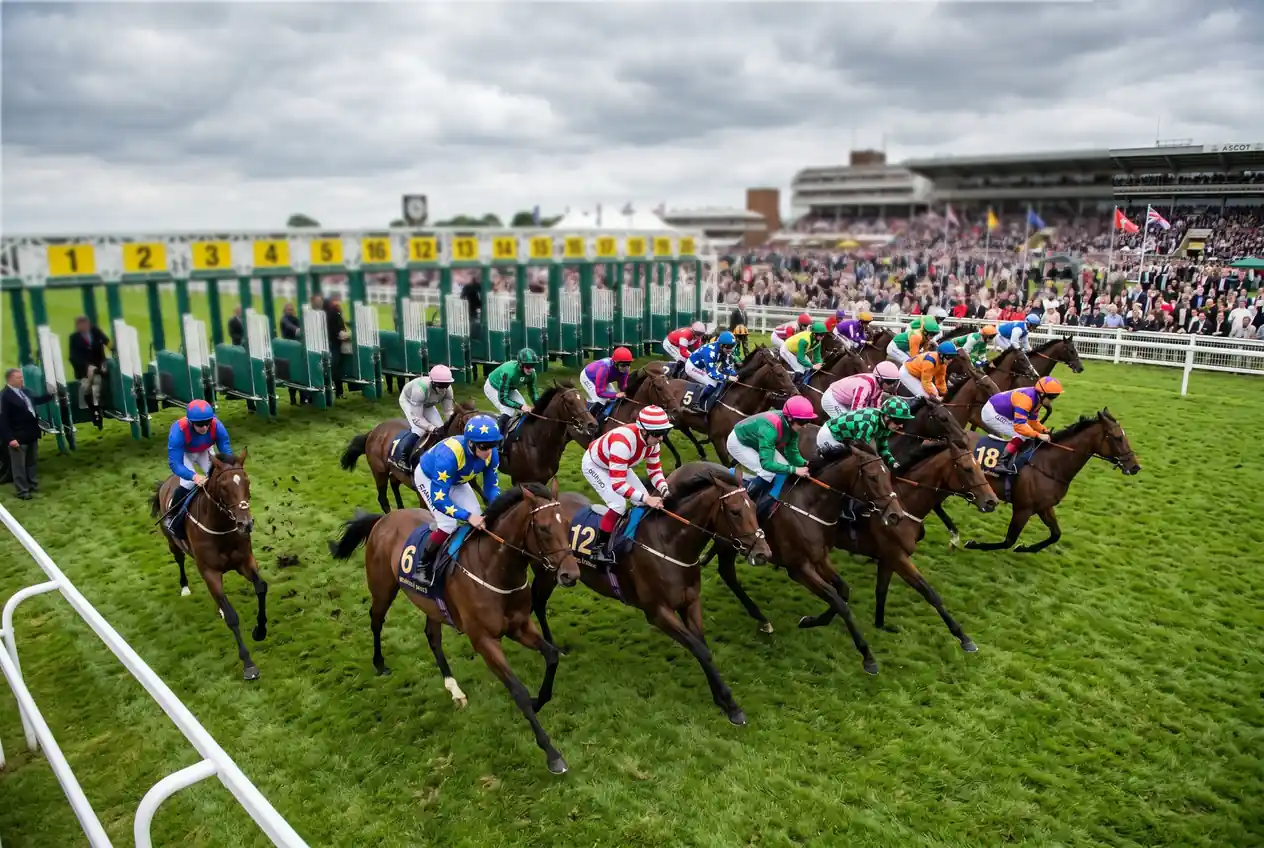
The Cesarewitch at Newmarket, 34 runners, a two-mile-two-furlong handicap that looks impossible to solve. I stared at the racecard for an hour, crossed out 20 horses based on form and going filters, and was left with six genuine contenders. My pick won at 14/1. The point is not the win — I have lost plenty of Cesarewitch bets too — but the process. Big-field handicaps look chaotic, and the chaos is precisely what creates value. In fields of 12 or more, favourites win roughly 27% of the time at average prices around 2/1. Compare that with small fields where the favourite hits 40%. The big field suppresses the market leader’s dominance and spreads the winning probability across more horses, which means the market is more likely to misprice something.
How the Handicap System Works: Weights, Official Ratings and the Handicapper’s Goal
The BHA handicapper assigns every horse a rating, and that rating determines the weight it carries. The goal is to give every horse a theoretically equal chance by loading the best horses with more weight and giving weaker horses a lighter burden. In practice, the system is imperfect — if it were perfect, every race would be a dead heat. The imperfection is where punters make money.
Ratings are updated after every run. A horse that wins impressively will see its rating rise, typically by 3-7 pounds. A horse that runs poorly might see a reduction. The “well-handicapped” horse is one whose current ability exceeds its official rating — often because the handicapper has not yet caught up with recent improvement or because the horse’s last few runs were on unsuitable ground and do not reflect its true level.
Understanding the handicapper’s timing is key. After a win, the rating rise takes effect immediately for future entries. A horse that won a Class 5 handicap off a rating of 70 might be reassessed to 77, which means it enters its next race carrying 7lb more. If the horse was only 2-3lb better than its rating suggested, the new mark makes it harder to win. If it was 10lb better, it is still well-handicapped despite the rise. Spotting horses in the second category is the core skill of handicap betting.
Narrowing the Field: Six Filters That Cut 20 Runners to Five
I apply six sequential filters to every big-field handicap. Each filter eliminates horses, and the ones left standing after all six are my shortlist. Around 80% of UK races are won by the top 20% of trainers and jockeys, and the filtering process starts with that reality.
Filter one: going. Eliminate horses with no form or poor form on today’s going. In a 20-runner field on soft ground, this typically removes five to eight runners immediately. Filter two: distance. Exclude horses that have never won at today’s distance or within a furlong of it. Filter three: class. Remove horses dropping from a significantly higher class if their recent form does not support the drop, and remove horses rising sharply in class with no evidence they can handle the step up.
Filter four: recent form. Require at least one run in the last 30 days or a trainer with a strong record with fresh horses. Long absences introduce unknown variables. Filter five: connections. Check trainer and jockey strike rates at the course. A trainer who sends a horse 200 miles to a specific course is doing so for a reason. Filter six: weight trend. Horses that are running off a lower weight than their last winning mark (the “sliding handicap”) are better positioned than those running off a career-high rating.
After these six filters, a 20-runner field typically shrinks to four to six horses. That is a manageable shortlist you can analyse in depth, rather than trying to form an opinion on every runner and spreading your attention too thin.
Recommended online casinos
- BeOnBetBonus: 100% up to €500 + 100 FS · Payout speed: 1-3 business days
- Revery PlayBonus: 100% up to€1,000+ 100 FS · Payout speed: 1-3 business days
- ChanzeBonus: Slots Welcome Bonus #1 200% up to €500 · Payout speed: 1-3 business days
- JetsetspinsBonus: 200% Bonus + 100 Free Spins + Free Royal Wheel · Payout speed: 1-3 business days
- DieselwinBonus: Welcome Pack 250% up to £4000 + 200 FS · Payout speed: 1-3 business days
- ZombillionBonus: Welcome Pack 250% up to £4000 + 200 FS · Payout speed: 1-3 business days
- WinBeastBonus: €5000 + 500 FS + €650 Freebet · Payout speed: 1-3 business days
- NightWinBonus: £900 + 400 free spins · Payout speed: 1-3 business days
- SpinFormulaBonus: 550% Up To £15,000 + 550 FS · Payout speed: 1-3 business days
Unexposed Improvers vs Proven Performers: Where the Value Lies
Big-field handicaps attract two types of contender: proven horses running off known ability, and lightly raced “unexposed” horses whose ceiling is uncertain. The value proposition is different for each. Favourites in UK racing win 30-35% overall, but that figure masks the difference between race types. In competitive handicaps with 16+ runners, the favourite’s win rate drops and the finishing positions are more dispersed.
Proven performers are reliable but often fully exposed. A horse rated 90 that runs consistently to a figure of 88-92 is unlikely to produce a dramatic surprise. Its price reflects its known ability, and the value in backing it depends on whether the market has slightly underestimated its fitness, ground preference or weight advantage on the day.
Unexposed horses are higher risk but offer greater value. A four-year-old with only six career starts, a steadily rising rating and a run style that suggests it has more to give is the prototype. These horses have not yet hit their ceiling, and the handicapper is chasing a moving target. If the horse’s true ability is 10lb ahead of its current rating, it has a significant edge over the field. The risk is that unexposed horses are also more likely to flop — they might have physical issues the market cannot see, or their improvement might plateau at a level below what you estimated.
My approach is to blend both types on my shortlist. One or two proven horses for reliability, one or two unexposed horses for upside. The staking reflects the split: flat stakes on the proven ones, slightly smaller stakes on the unexposed picks to manage the higher failure rate.
Staking in Big Fields: Each-Way, Dutching or Multiple Shortlist Plays
Each-way betting is the default approach in big-field handicaps, and for good reason. With four or five places paid at one-quarter or one-fifth the odds, the place element of the bet provides a meaningful safety net. A 10/1 shot that finishes third in a 20-runner race pays roughly 3.5/1 on the place part alone — enough to cover the combined win-and-place outlay and return a small profit.
Dutching two or three shortlisted horses to win is an alternative when the place terms are not generous enough to justify each-way (in races with fewer than 16 runners, only three places are typically paid). Dutching delivers a higher profit if one of your selections wins, but nothing if they all finish out of the frame. The choice depends on your confidence level and the specific place terms on offer.
For the occasional big-field race where your shortlist produces three or four strong each-way contenders, splitting your total outlay across multiple each-way singles is more efficient than an accumulator. Each bet stands independently, so one loser does not destroy the others. The total outlay is higher, but the probability of at least one bet collecting is substantially better than a multi-leg accumulator where every horse must perform.
Should I always bet each-way in a 20-runner handicap?
Each-way is the most common approach because the extended place terms (four or five places) provide a safety net. However, if you have a strong opinion that one horse will win rather than just place, a win-only bet at the full odds can return more. Consider each-way when your selection is priced at 8/1 or longer, where the place element becomes valuable enough to justify the extra stake.
How do I spot an unexposed improver in a competitive handicap?
Look for horses with fewer than ten career starts, a steadily rising official rating, and a finishing effort in recent races that suggests they were not fully extended. Physical indicators include a lightly raced four-year-old whose trainer is known for patient development, first-time headgear application, or a step up in trip that suits the horse’s pedigree. Combine these signals rather than relying on any single one.
Does pace analysis matter more in handicaps than in conditions races?
Yes. In big-field handicaps, the pace scenario — how fast the race is run in the early stages — directly affects which running style is favoured. A strongly run race advantages hold-up horses who can finish fast. A slowly run race favours prominent racers who kick for home from the front. Checking how many front-runners are in the field gives you a clue about the likely pace, which in turn helps you select horses with the right running style.
The full picture is in our data-driven guide to horse racing betting.
Big fields widen the places: each-way betting.
Written by the editors at Tips for Horse Racing Betting.