Horse Racing Betting for Beginners: Your First 10 Bets Mapped Out Step by Step
Best Horse Racing Betting Sites – Bet on Horse Racing in 2026
 Available in US
Table of Contents
- You Do Not Need to Understand Everything Before Placing Your First Bet — but You Do Need a Plan
- Recommended online casinos
- What You Need Before Your First Bet: Account, Bank and a Basic Toolkit
- Bets 1-3: Simple Win Bets on Short-Field Races
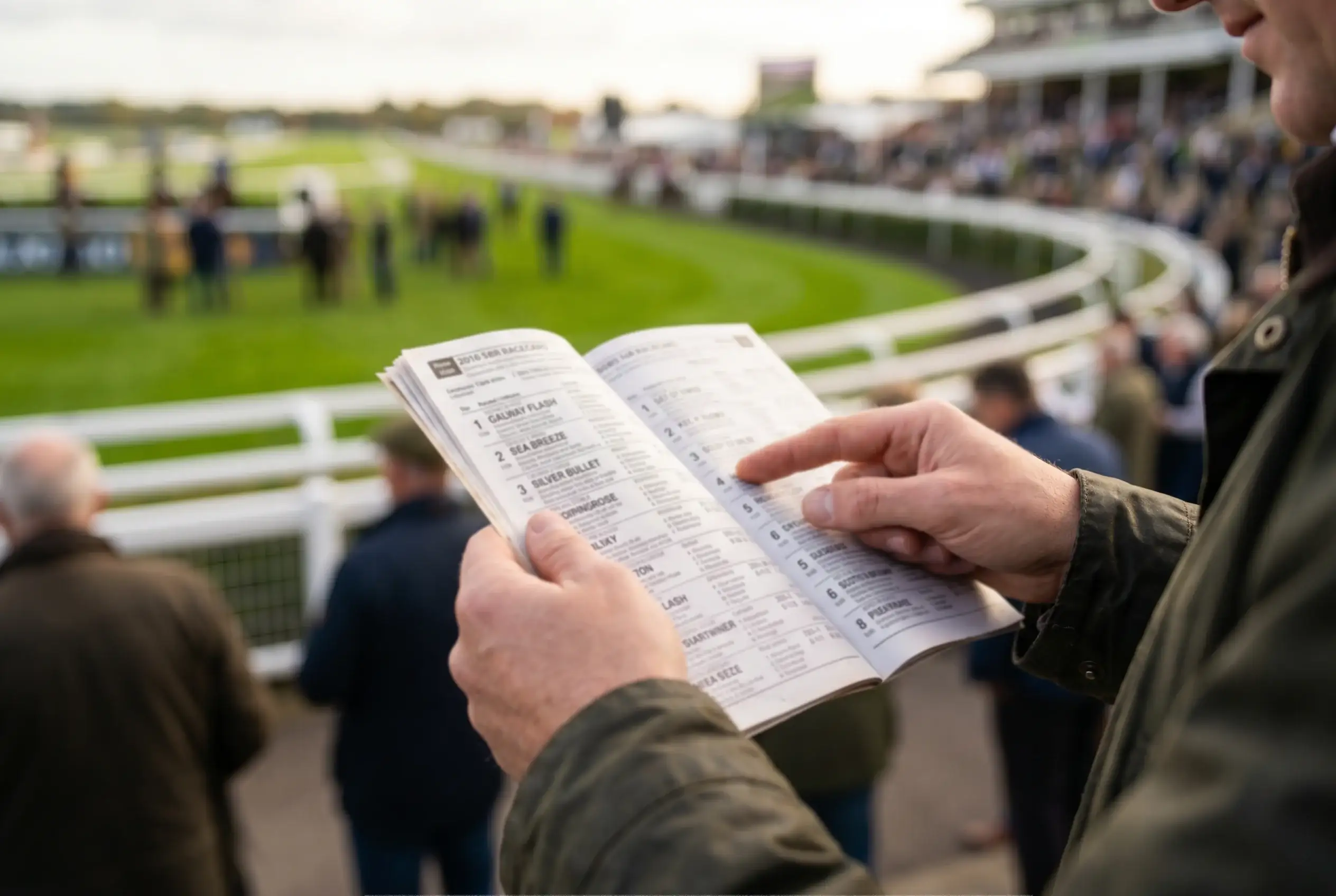
- Bets 4-7: Adding Each-Way and Learning to Read the Racecard
- Bets 8-10: Introducing Form Analysis and Tracking Results
- Beyond Ten Bets: Building Towards a Systematic Approach
You Do Not Need to Understand Everything Before Placing Your First Bet — but You Do Need a Plan
Nearly half of all UK adults participate in some form of gambling, and horse racing remains one of the most popular entry points. Yet most beginners make the same mistake I made: they jump straight in on a Grand National or a big Saturday card, lose their first tenner and either give up or develop habits that cost them money for years. You do not need to know the entire sport before placing your first bet — but you do need a structured path that teaches you something useful with every wager.
What follows is the sequence I wish someone had given me when I started. Ten bets, in a specific order, each designed to build one practical skill. By bet ten, you will understand the basics of race selection, form reading, staking and record-keeping. None of this requires expertise. It requires patience and a willingness to treat your early bets as tuition rather than income.
Recommended online casinos
- BeOnBetBonus: 100% up to €500 + 100 FS · Payout speed: 1-3 business days
- Revery PlayBonus: 100% up to€1,000+ 100 FS · Payout speed: 1-3 business days
- ChanzeBonus: Slots Welcome Bonus #1 200% up to €500 · Payout speed: 1-3 business days
- JetsetspinsBonus: 200% Bonus + 100 Free Spins + Free Royal Wheel · Payout speed: 1-3 business days
- DieselwinBonus: Welcome Pack 250% up to £4000 + 200 FS · Payout speed: 1-3 business days
- ZombillionBonus: Welcome Pack 250% up to £4000 + 200 FS · Payout speed: 1-3 business days
- WinBeastBonus: €5000 + 500 FS + €650 Freebet · Payout speed: 1-3 business days
- NightWinBonus: £900 + 400 free spins · Payout speed: 1-3 business days
- SpinFormulaBonus: 550% Up To £15,000 + 550 FS · Payout speed: 1-3 business days
What You Need Before Your First Bet: Account, Bank and a Basic Toolkit
Before anything else, you need a licensed UK betting account with a UKGC-regulated operator. 95% of online gambling in the UK happens from home, and the signup process takes minutes. Choose an operator that offers Best Odds Guaranteed on horse racing, because it means you automatically receive the higher price if SP drifts above the odds you took. Do not worry about exchange accounts yet — they can come later.
Set a dedicated betting bank. This is money you can afford to lose entirely, ring-fenced from your day-to-day finances. For your first ten bets, I would suggest a total bank of between 20 and 50 pounds. Each bet will be a fixed percentage of that bank — ideally 5%, so between one and two pounds fifty per bet. This sounds small because it should be small. The purpose of these bets is learning, not earning.
Your basic toolkit is a device with internet access, a notepad or spreadsheet for recording results, and the Racing Post website or app for free racecards and form data. That is all. You do not need subscriptions, tipping services or software at this stage.
Bets 1-3: Simple Win Bets on Short-Field Races
Your first three bets are straightforward win bets — you pick one horse, and you get paid if it finishes first. Start with races that have small fields: five to eight runners. Favourites in fields of six win roughly 40% of the time at average prices just above even money, which gives you a reasonable chance of experiencing a winner early. That early reinforcement matters more than most people realise; it keeps you engaged with the process rather than discouraged by a losing streak before you have learned anything.
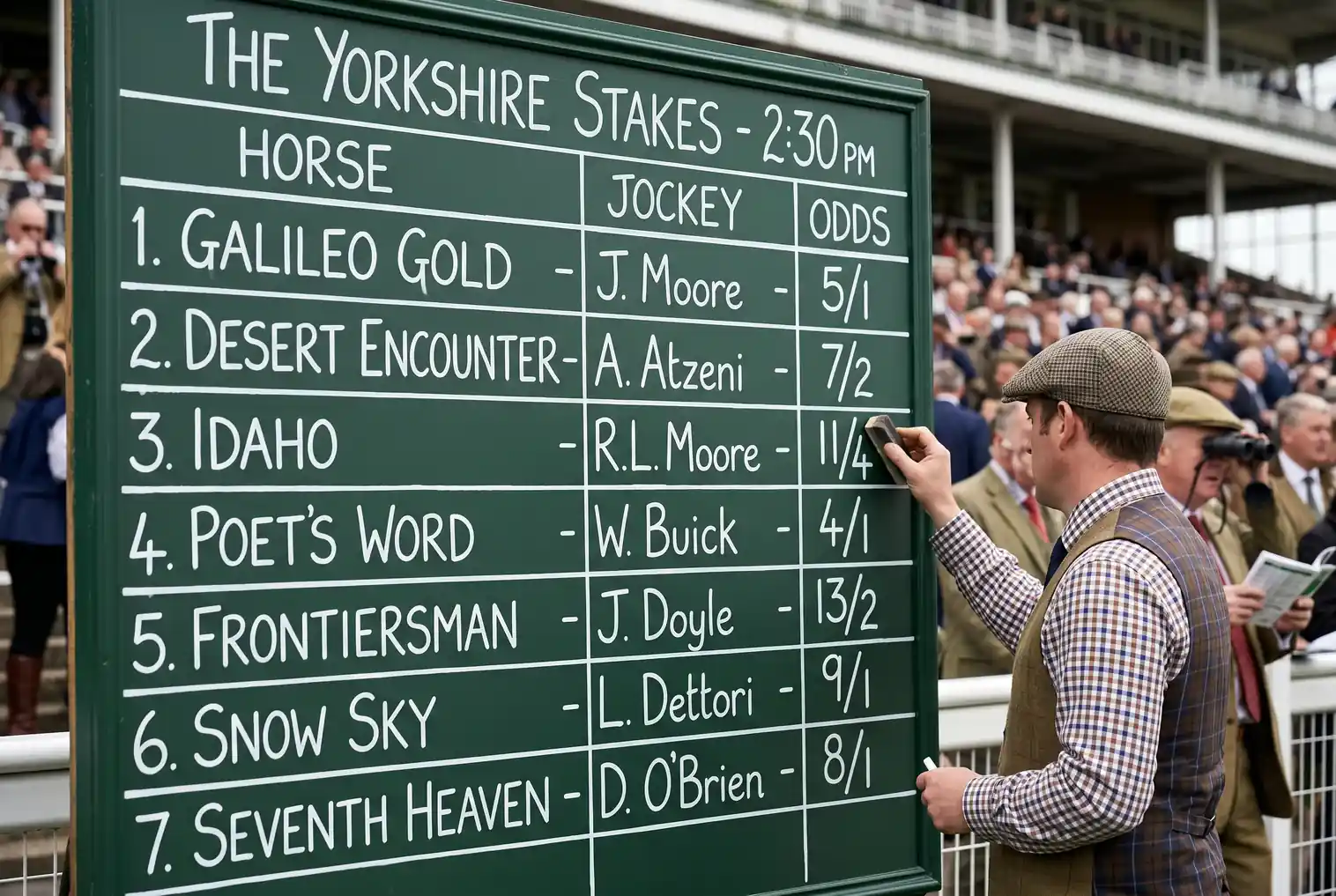
For each of these three bets, pick a race at a weekday afternoon meeting — not a Saturday festival card, where the competition is fiercer and the fields larger. Look at the racecard and identify the favourite (the horse with the shortest odds). Read the brief form commentary. Does the horse have recent form at today’s distance and going? Has it won before at this track? If the answer to at least one of those questions is yes, back it as a simple win bet at your fixed stake.
After each bet, win or lose, write down: the horse’s name, the odds you took, the result, and one sentence about why you chose it. This is the start of your betting record, and it is more valuable than any winner.
Bets 4-7: Adding Each-Way and Learning to Read the Racecard
By bet four, you should be comfortable navigating a racecard and placing a win bet. Now we introduce each-way betting — a bet structure where you back a horse to win and separately to finish in the places (usually top two, three or four depending on field size and the number of runners). Each-way bets cost double your stake because they are effectively two bets, so adjust accordingly.
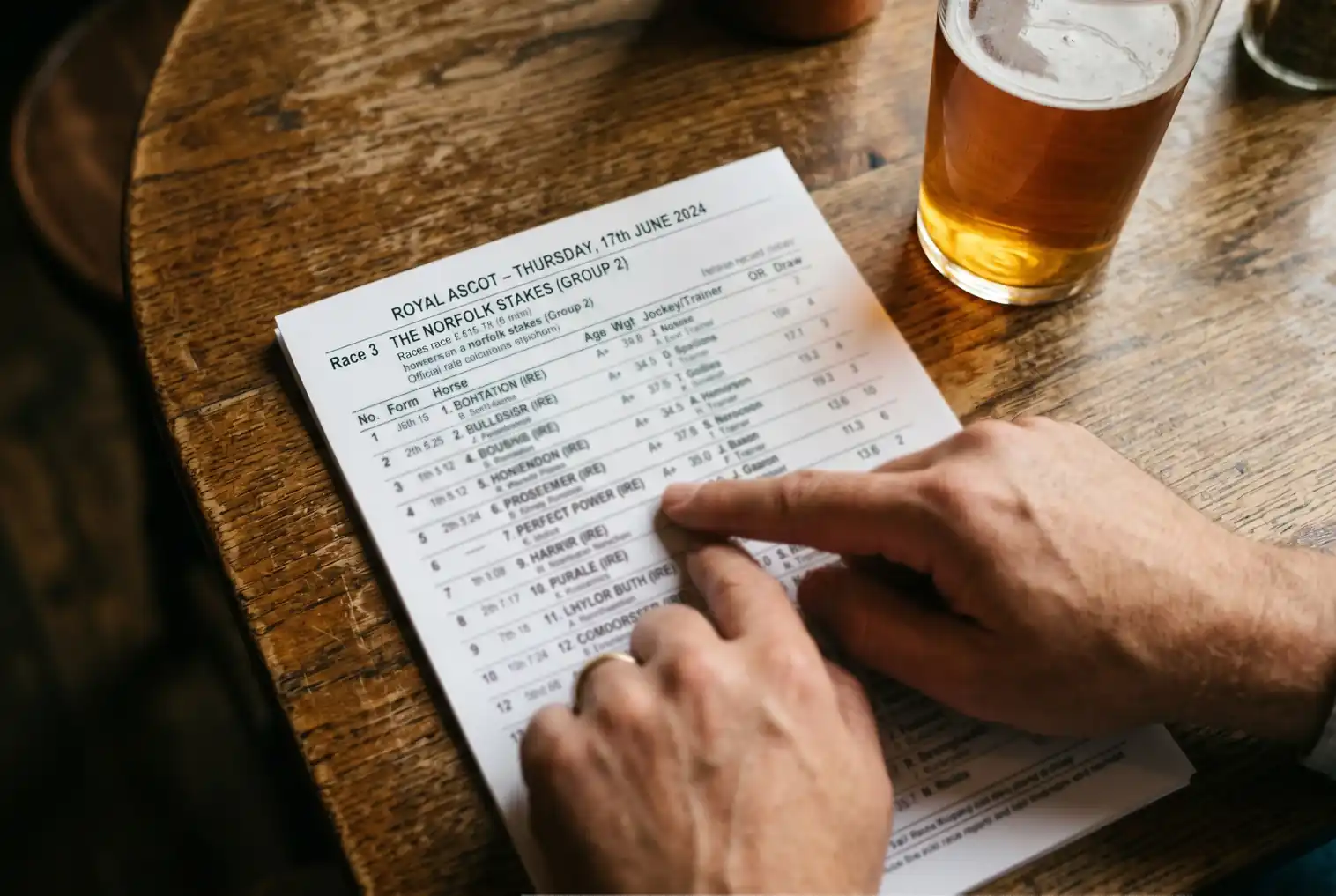
For bets four and five, pick races with ten or more runners and select a horse priced between 6/1 and 14/1 that you think has a reasonable chance of finishing in the first three or four. Read the form more carefully this time: look at the form figures (the numbers next to the horse’s name showing recent finishing positions), check whether the trainer and jockey combination has a decent record, and consider the going. You are not expected to master form analysis yet — you are expected to start the habit of looking beyond the odds.
Bets six and seven give you free choice: any race, any type of bet (win or each-way), with one condition. Before placing the bet, write down your reasoning in at least three sentences. Why this race? Why this horse? What could go wrong? If you cannot write those three sentences convincingly, skip the race and find one where you can.
Bets 8-10: Introducing Form Analysis and Tracking Results
For your final three bets, spend at least twenty minutes studying the racecard before selecting. Look at the full form string for each horse — the sequence of finishing positions across recent races. Look for patterns: has the horse been improving (finishing closer each time), or declining? Check the going preference: does this horse run better on soft ground or firm? Check the trainer’s current form by glancing at their recent runners across all tracks.
These three bets should each take you longer to prepare than the first seven. That is the point. You are practising the process of pre-race analysis, and time invested before the bet is the single biggest differentiator between punters who lose steadily and those who break even or better. By now your record should contain ten entries with dates, selections, odds, results and reasoning. Look back through it. Can you see which selections had stronger reasoning and which were closer to guesses?
Do not worry if your overall P&L after ten bets is negative. The return on investment for blindly backing favourites across thousands of races is roughly 93% — a net loss. As a beginner with ten bets to your name, you are learning the mechanics and building the habits. Profitability comes from refining the process over hundreds of bets, not from the first ten.
Beyond Ten Bets: Building Towards a Systematic Approach
Once you have completed ten structured bets, you face a choice. You can continue betting casually — a flutter on the weekend when you fancy it — or you can start building a systematic approach. If the second option appeals to you, the next steps are specialisation and record-keeping discipline.
Specialisation means narrowing your focus. Instead of betting across every race type and every track, pick one area — maybe sprint handicaps at northern tracks, or novice hurdles in the winter — and learn it deeply. Specialists build genuine knowledge advantages that generalists cannot match. And keep recording every bet: horse, race, odds taken, result, reasoning, profit or loss. After fifty bets in a single niche, the patterns in your own data will tell you more about where your edge lies than any tipping service ever could.
What is the minimum stake I can place on a horse race in the UK?
Most online bookmakers accept minimum stakes of between 1p and 10p for a single bet. In practice, a minimum of one pound per bet gives you enough to engage meaningfully without risking significant money while learning.
How do I open a betting account in the UK?
You need to be 18 or over and have a UK address. Choose a UKGC-licensed operator, complete the registration form with your name, date of birth and address, verify your identity (usually with a photo ID) and deposit funds using a bank card or e-wallet. The entire process typically takes under ten minutes.
Should a beginner bet on big races like the Grand National?
Big races are exciting but they feature the most competitive fields and the most complex form. As a beginner, you learn more from smaller, less competitive meetings where the form is easier to read and the market is less sharp. Once you are comfortable with the basics, big races make a natural next step.
The full picture is in our data-driven guide to horse racing betting.
The words you will meet: the betting glossary.
Created by the ”Tips for Horse Racing Betting” editorial team.