Horse Racing Betting Strategy: Systematic Methods That Withstand Losing Runs
Best Horse Racing Betting Sites – Bet on Horse Racing in 2026
 Available in US
Table of Contents
- A Betting Strategy Is Not a Tip — It Is a Decision Framework
- Recommended online casinos
- Specialise to Win: Picking Your Racing Niche
- The Pre-Race Process: A Repeatable Analytical Workflow
- Staking Discipline: Flat, Percentage and Kelly Criterion
- Record Keeping and Performance Review: Measuring What Matters
- Adapting Strategy Across Seasons and Codes
- Strategy Killers: Overcomplication, Chasing and Confirmation Bias
- Frequently Asked Questions

A Betting Strategy Is Not a Tip — It Is a Decision Framework
I spent my first three years backing horses based on tips. Newspaper naps, forum selections, a mate who “knew” a trainer. Some tipped horses won. Most did not. My records — and I did keep records, even then — showed a return on investment of about 91p for every pound staked. Slightly worse than the 93p you get from blindly backing every favourite. All that effort, all those “inside” picks, and I was performing worse than a dartboard pointed at the front of the market.
The turning point was understanding that a strategy is not a better source of tips. It is a repeatable process for making decisions — when to bet, when to pass, how much to stake, how to review results. A tip tells you what to do once. A strategy tells you how to think every time. The distinction sounds abstract until you live through a fifteen-bet losing run and realise that without a framework, your natural instinct is to chase losses, double stakes, or abandon your approach entirely. A strategy gives you the structure to survive the variance that is built into horse racing.
This article lays out the components of a systematic approach: specialisation, a pre-race analytical workflow, staking discipline, record keeping, seasonal adaptation, and the psychological traps that destroy even sound strategies. Every section draws on methods I have tested across more than nine years and thousands of bets. Not all of them are glamorous. Most of them are not. The glamorous part is the result — a process you can trust when the results are going against you.
Recommended online casinos
- BeOnBetBonus: 100% up to €500 + 100 FS · Payout speed: 1-3 business days
- Revery PlayBonus: 100% up to€1,000+ 100 FS · Payout speed: 1-3 business days
- ChanzeBonus: Slots Welcome Bonus #1 200% up to €500 · Payout speed: 1-3 business days
- JetsetspinsBonus: 200% Bonus + 100 Free Spins + Free Royal Wheel · Payout speed: 1-3 business days
- DieselwinBonus: Welcome Pack 250% up to £4000 + 200 FS · Payout speed: 1-3 business days
- ZombillionBonus: Welcome Pack 250% up to £4000 + 200 FS · Payout speed: 1-3 business days
- WinBeastBonus: €5000 + 500 FS + €650 Freebet · Payout speed: 1-3 business days
- NightWinBonus: £900 + 400 free spins · Payout speed: 1-3 business days
- SpinFormulaBonus: 550% Up To £15,000 + 550 FS · Payout speed: 1-3 business days
Specialise to Win: Picking Your Racing Niche
There are roughly 1,500 fixtures and over 10,000 individual races on the UK racing calendar every year. If you try to bet on all of them, you will drown in data and make lazy decisions. Specialisation is the most underrated edge in horse racing betting. The professional punters I respect all have a niche — and the narrower it is, the deeper their knowledge, and the more consistently they find value.
Richard Wayman, BHA’s Director of Racing, noted that total betting turnover fell 9% in early 2025 compared to the previous year, while the number of recreational punters betting on racing was actually growing. That divergence — less money per bettor, more bettors overall — suggests a market where casual punters are spreading their stakes thinly across many races. Specialists do the opposite. They concentrate their attention on a subset of races where they can build genuine expertise and exploit situations that generalists miss.
Your specialisation might be defined by race type: Class 3–4 handicaps on the Flat over a mile to a mile and a half, for instance. Or by code: National Hunt novice hurdles. Or by track: if you live near a particular racecourse, you can watch the racing live, observe the ground conditions, and build course-specific knowledge that no database replicates perfectly. Some punters specialise by method — they become exceptional at reading speed figures, or at identifying draw biases, or at analysing trainer patterns at specific venues.
The key is that specialisation imposes a filter. Instead of asking “can I find a bet in this race?” for every race on the card, you ask “does this race fall within my area of expertise?” If it does not, you skip it. That discipline eliminates the majority of bad bets — the ones placed out of boredom, out of action-seeking, or out of vague impressions that “something looks good.” When turnover on Core Fixtures dropped 8.6% against 2024 while Premier Fixtures rose 2.7%, part of the story is that sharper punters are concentrating on the races with the most data and the most competitive markets. You should do the same, within whatever niche suits your knowledge and time.
The Pre-Race Process: A Repeatable Analytical Workflow
Every profitable punter I know has a process they run before placing a bet. Not a feeling, not a hunch — a checklist of analytical steps they complete in the same order every time. My own process took two years to refine, and it has barely changed since. Here it is, laid out in the sequence I actually follow.
First, I identify races within my specialisation. On a typical midweek card, that might mean three races out of six qualify. On a Saturday with multiple meetings, it could be five or six across different tracks. Everything else gets ignored — no exceptions, no “just a quick look at the 3:30.” Discipline at this stage saves me from the low-quality bets that erode bankrolls.
Second, I eliminate runners that do not fit the race conditions. Going preferences, class suitability, distance profile — the filters I described in the form analysis context. About 80% of races are won by the top 20% of trainers and jockeys at any given track, so I also check whether each remaining horse has connections that perform at the required level. This elimination pass typically cuts a twelve-runner field down to four or five genuine contenders.
Third, I rank the remaining horses by form strength. Recent runs, speed figures, course form, headgear changes, jockey bookings. Each factor gets a mental weighting rather than a formal score — I tried numerical scoring early on and found it created false precision. The ranking is more like a conversation: “This horse has the best recent form but untested going. That horse is a class dropper with a strong jockey booking. The third has the best speed figure but is stepping up in distance.” The goal is a shortlist of one or two horses I would be willing to back.
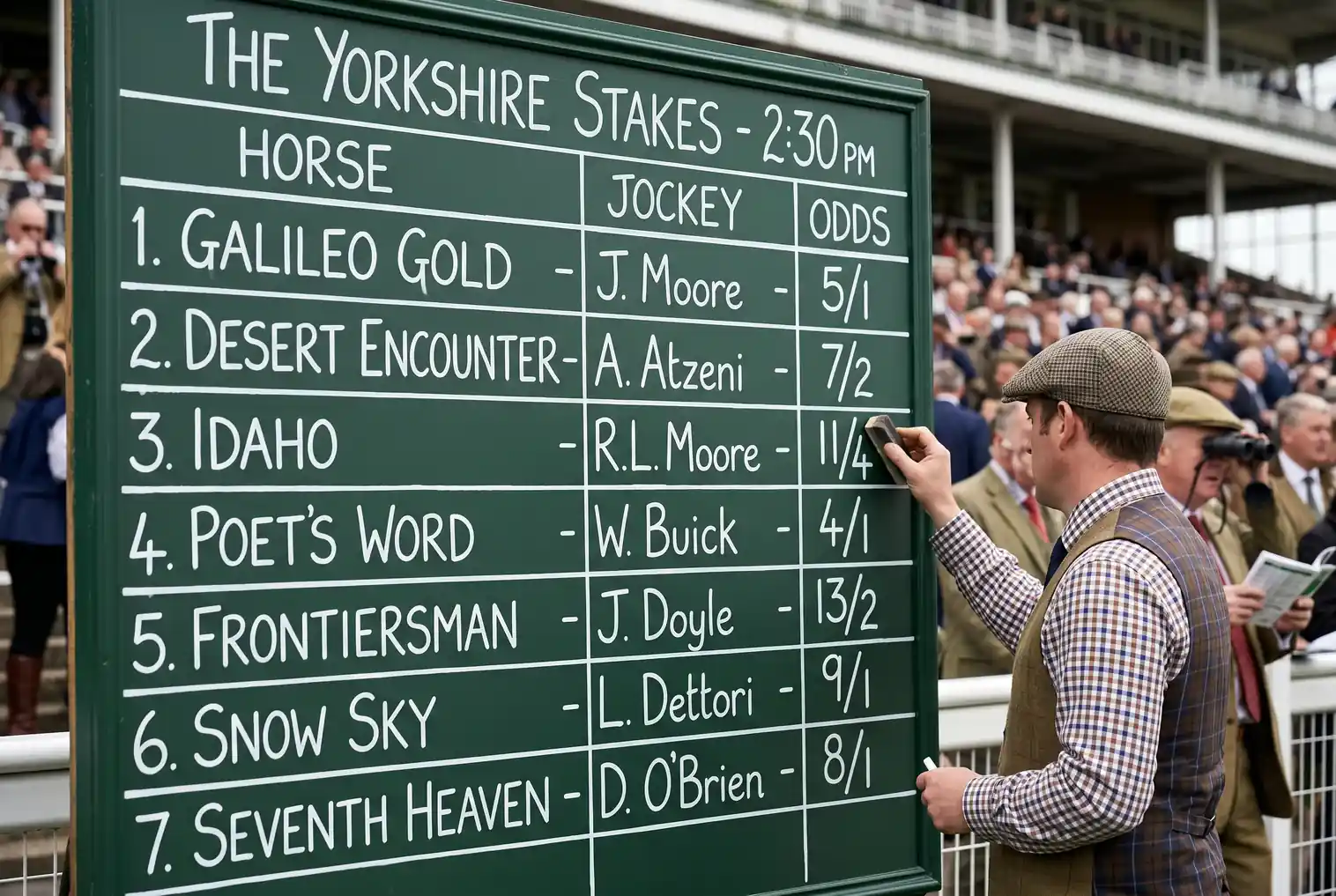
Fourth, I estimate each shortlisted horse’s win probability. This is the hardest step and the one most punters skip entirely. I am not claiming my probability estimates are perfectly calibrated — nobody’s are. But the act of assigning a number, even a rough one, forces you to think quantitatively. If I rate a horse at a 20% chance and the market is offering 6/1 (implied probability 14.3%), I have a potential value bet. If the market is offering 3/1 (implied probability 25%), the price is too short relative to my estimate.
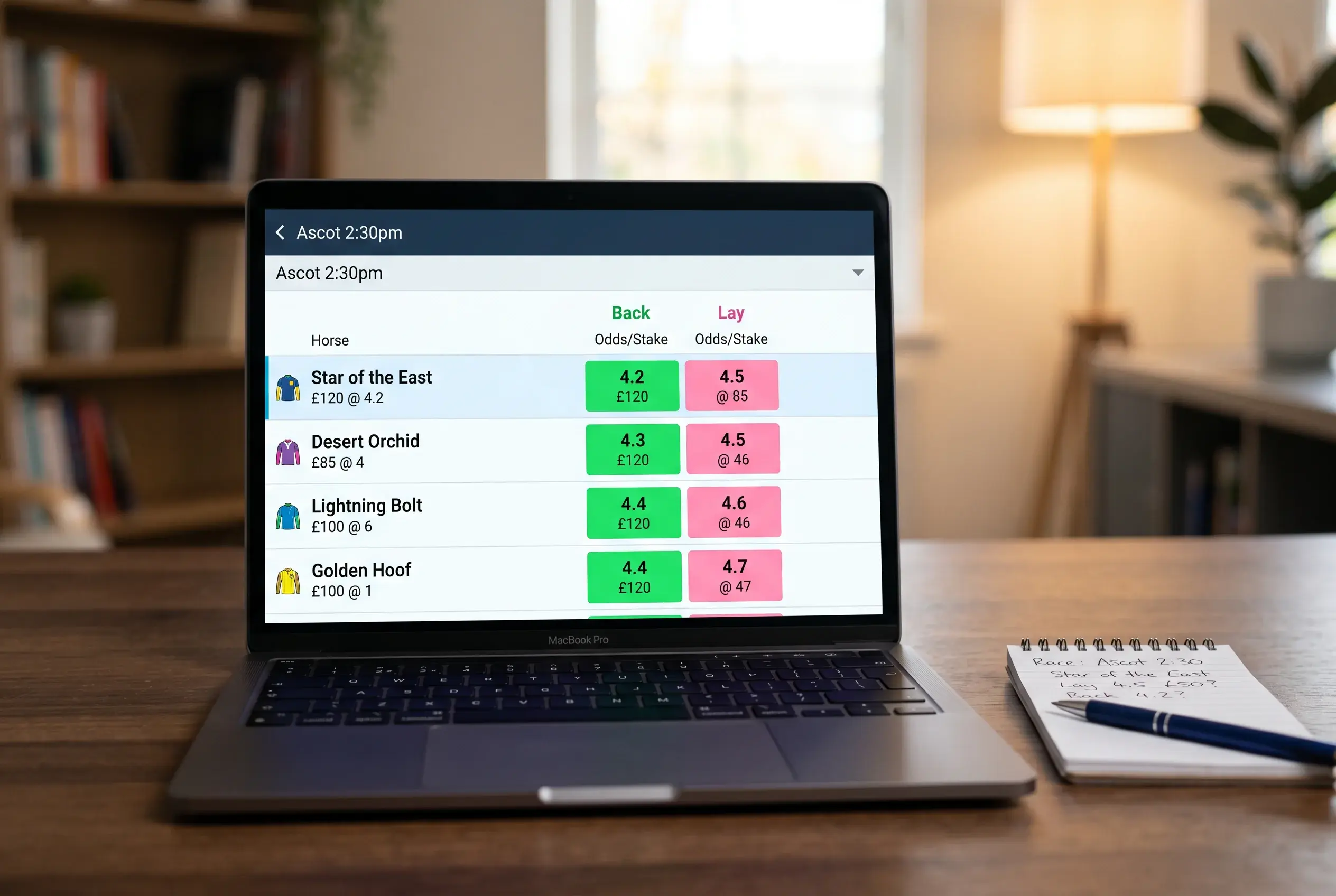
Fifth, I check the market. If value exists — my estimated probability exceeds the implied probability after adjusting for the overround — I place the bet at the best available price. If there is no value, I pass. Passing is the most important skill in this entire workflow. On some days I analyse six races and bet on none of them. That is not a wasted afternoon — that is the process working exactly as it should.
The whole sequence takes about fifteen minutes per race. For a focused session of four or five races, roughly an hour. Trying to shortcut it — skipping the elimination step, eyeballing the probability rather than estimating it, not checking odds across bookmakers — costs more in poor results than the time it saves.
Staking Discipline: Flat, Percentage and Kelly Criterion
Your selection process might be excellent, but if your staking is chaotic, you will still lose money. I learned this the hard way during a three-month spell when my strike rate and average odds were both healthy, yet my bank barely grew because I was staking large on low-confidence bets and small on high-confidence ones — the exact opposite of what rational staking demands.
Flat staking is the simplest approach: every bet is the same fixed amount, regardless of the odds or your confidence level. If your bank is £1,000 and you stake 2% per bet, every wager is £20. The advantage is simplicity and emotional discipline — there is no temptation to increase stakes after a win or a loss. The disadvantage is that you treat a 2/1 shot you are highly confident about the same as a 10/1 shot you rate as speculative. Flat staking ignores the information your own analysis generates about confidence levels.
Percentage staking adjusts the bet size as your bank fluctuates. You still risk the same percentage — say, 2% — but the actual pound amount changes. If your bank grows to £1,200, the stake becomes £24. If it shrinks to £800, the stake drops to £16. This automatically reduces exposure during losing runs and increases it during winning ones, which is mathematically sound bankroll protection.
The Kelly Criterion takes this further by incorporating your edge into the calculation. The basic Kelly formula is: stake = (edge / odds), where edge is your estimated probability minus the implied probability. If you rate a horse at 25% and the market implies 20% (5/1), your edge is 5 percentage points, and Kelly suggests staking 5% divided by 5 = 1% of your bank. Full Kelly is aggressive — most experienced punters use half-Kelly or quarter-Kelly to reduce variance. For a deeper exploration of the maths and how to size your bank for different staking approaches, the detail in bankroll management for horse racing goes beyond what I can cover here.
Blindly backing favourites produces a return of roughly 93p per pound — a 7% drain. That number is the baseline you are trying to beat, and staking discipline is what prevents you from falling below it even when your selections are sound. The most destructive staking behaviour is chasing: increasing your stake after a loss to try to recover the deficit quickly. Chasing turns a manageable losing run into a bankroll-ending catastrophe. Whatever staking method you choose, the non-negotiable rule is consistency. Pick a method, commit to it, and do not deviate because of emotion.
Record Keeping and Performance Review: Measuring What Matters
If you do not track your bets, you do not have a strategy — you have a hobby with receipts. I started recording every bet in a spreadsheet on day one, and it is the single habit that has contributed most to my improvement over nine years. Not because the spreadsheet finds winners, but because it tells me the truth about my own performance when my memory would tell me something more flattering.
The minimum fields to record: date, race, horse, odds taken, stake, result, return, running profit/loss. That gives you the raw data. The useful analysis sits on top: strike rate (winners divided by total bets), ROI (profit divided by total stakes), average odds of winners, average odds of losers, performance by race type, performance by odds band, performance by month. Each metric tells you something different about where your process is working and where it is leaking money.
Strike rate without ROI is meaningless. A 40% strike rate at an average winning price of 6/4 produces a different outcome to a 15% strike rate at an average winning price of 8/1. The first gives you frequent small wins; the second gives you long losing runs punctuated by bigger paydays. Neither is inherently better — what matters is whether the combination of strike rate and average odds produces a positive ROI over a meaningful sample.
A meaningful sample is at least 200 bets of the same type, ideally 500 or more. Anything less and variance dominates. You might look brilliant after 50 bets — or terrible — and neither impression reflects the underlying quality of your process. Monthly reviews are useful for catching obvious problems (am I betting too many races? Am I straying outside my specialisation?), but strategic conclusions need larger samples.
I review my records quarterly and look for three things: is my overall ROI positive or trending towards positive? Are there specific race types or tracks where I consistently perform better or worse? And is my staking consistent with my stated plan? The third question catches more problems than the other two, because staking drift — gradually increasing stakes without formal justification — is the most common way disciplined punters quietly lose their edge.
Adapting Strategy Across Seasons and Codes
UK racing operates on two overlapping calendars, and treating them as a single continuous season is a mistake that cost me money early on. The Flat season runs from roughly April to October, centred on turf racing at tracks like Newmarket, Ascot, York, and Goodwood. The National Hunt season peaks from November to April, with Cheltenham in March as the centrepiece. All-weather racing fills the gaps year-round.
Betting participation reflects this seasonality. Data from the Gambling Commission shows racing participation at 7% during the April–July window when the major Flat festivals are running, dropping to 4% in the July–October period as the summer Flat season winds down and before the jumps calendar ramps up. That swing matters for bettors because market liquidity, field sizes, and the type of races available all change with the seasons.
On the Flat, the emphasis is on speed, draw, and form analysis over relatively short distances. Two-year-old racing in the spring and summer involves horses with limited form — sometimes just one or two runs — which makes trainer patterns and breeding analysis more important. Older horses on the Flat tend to have more established form profiles, and the handicap system creates the big-field competitive races that suit systematic approaches.
Over jumps, stamina, jumping ability, and ground conditions dominate. Horses have longer careers, which means deeper form books but also more opportunity for regression and injury. The going changes dramatically through the winter — a horse might encounter good ground in October and heavy ground in January, and its form can flip entirely between the two. Overall turnover on British racing dropped 12.8% over the first nine months of 2025 compared to 2023, and much of that decline concentrated in the everyday jump cards rather than the premium fixtures.
My approach adapts in specific ways. During the Flat season, I focus on handicaps over a mile to a mile and a half at the bigger tracks, where form data is richest and field sizes create each-way opportunities. During the jumps season, I shift to novice hurdles and lower-grade chases where the form book is less exposed and the market is less efficient. The transition months — October and April — I treat as low-activity periods, reducing my volume of bets while the data from the new season builds up enough to be reliable.
Strategy Killers: Overcomplication, Chasing and Confirmation Bias
The best strategy in the world fails if the person executing it sabotages themselves. I have done all three of the things described in this section, and I know from painful experience that recognising the pattern is easier than stopping it. But awareness helps — if you can name the trap while you are falling into it, you at least have a chance of pulling back.
Overcomplication is the first killer. There is a temptation to keep adding variables to your analysis — wind speed, paddock observations, rail movements, social media sentiment, the colour of the jockey’s silks. Each variable feels like it adds information, but beyond a point, extra complexity creates noise rather than signal. My process uses five core filters. I have tested versions with eight and ten filters, and the results were no better — they were slightly worse, because the extra analysis time meant I either rushed the important steps or bet on fewer races.
Chasing is the second killer and the most financially dangerous. A losing run creates a psychological deficit — a gap between where your bank is and where you feel it should be. The natural instinct is to close that gap by increasing stakes. This is catastrophic. A ten-bet losing streak is entirely normal for a punter with a 20% strike rate (which is good). Doubling your stakes during that streak does not make the next winner arrive sooner — it just makes the losses twice as expensive. The antidote is your staking plan. Follow it mechanically. If the plan says two percent of the bank, stake two percent of the bank. No negotiation, no exceptions.
Confirmation bias is the subtlest killer. After you identify a selection, your brain starts filtering information to support the decision. The speed figure looks strong — good. The going might not be ideal — well, the horse has not been tested on it, so maybe it will handle it. The jockey has a low strike rate at this track — probably just bad luck. Each rationalisation individually sounds reasonable. Collectively, they blind you to evidence that should make you reconsider. I counteract this by actively looking for reasons not to back a horse after completing my initial analysis. If I cannot find at least one legitimate concern, I am probably not looking hard enough.
Frequently Asked Questions
How many races should I bet on per day using a systematic approach?
There is no fixed number, because it depends on your specialisation and the day’s card. On a quiet midweek day, I might find one qualifying race across all meetings. On a busy Saturday, three or four. The important principle is that quality of selection always overrides volume. If no race meets your criteria, the correct number of bets for that day is zero.
Is the Kelly Criterion practical for recreational horse racing punters?
Full Kelly is too aggressive for most people because it assumes perfect probability estimates, which nobody has. Half-Kelly or quarter-Kelly is more practical — it provides a mathematically grounded staking framework without the severe bankroll swings of full Kelly. If estimating probabilities feels uncomfortable, flat staking at 1-2% of your bank is a perfectly sound alternative.
How long does it take to know whether a strategy is working?
You need a minimum of 200 bets to draw any reliable conclusions, and 500 or more to be confident. At two or three bets per day, 200 bets takes roughly three months. Shorter samples are dominated by variance — you might look profitable or unprofitable due to luck rather than skill. Track your results from day one, but resist making strategic changes until the sample is large enough to be meaningful.
The full picture is in our data-driven guide to horse racing betting.
Every strategy rests on finding value.
Published by the Tips for Horse Racing Betting team.