
Favourite Horse Racing Statistics: Win Rates by Price, Field Size and Race Type
Best Horse Racing Betting Sites – Bet on Horse Racing in 2026
 Available in US
Table of Contents
- Favourites Win About a Third of All Races — but That Headline Number Hides Enormous Variation
- Overall Favourite Win Rates: Flat, National Hunt and All-Weather
- Recommended online casinos
- Win Rates by Price Bracket: Odds-On to 10/1 and Beyond
- How Field Size Shifts Favourite Performance
- Second and Third Favourites: The Numbers Most Punters Ignore
- The ROI of Blindly Backing Favourites: Why Win Rate Is Not Enough
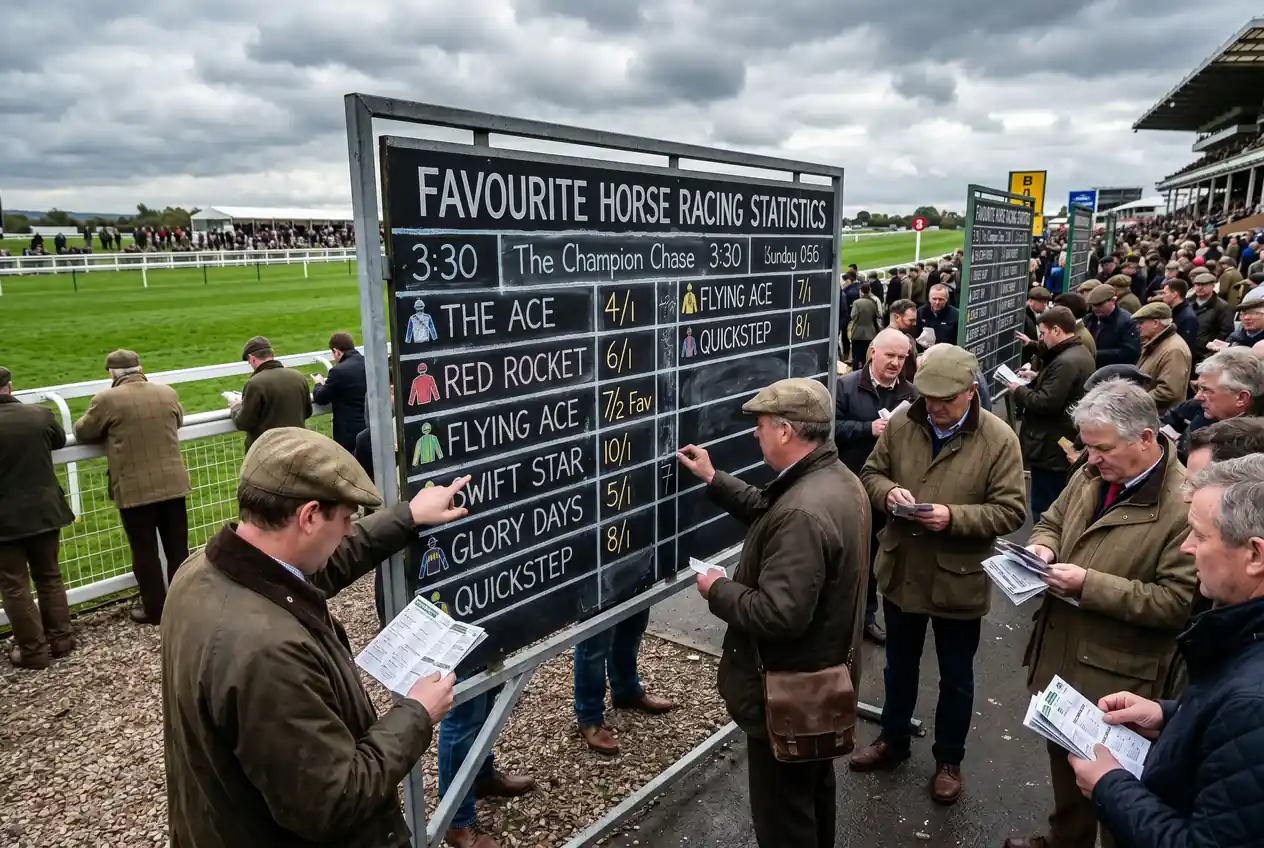
Favourites Win About a Third of All Races — but That Headline Number Hides Enormous Variation
I have lost count of the times someone at the races has told me they “always back the favourite.” When I ask how that is working out, the answer is usually a shrug. The instinct is understandable — if the market thinks a horse is the most likely winner, why fight it? But “about a third” is a blunt number that disguises sharp variations depending on the price, the field size and the type of race. Favourites in UK horse racing win approximately 30-35% of the time, and that range alone tells you the headline is unreliable. The detail underneath is where the actionable insight sits.
Overall Favourite Win Rates: Flat, National Hunt and All-Weather
Across UK flat racing, the market favourite wins roughly 33% of races. Over jumps, the rate is slightly lower — closer to 29-30% — because National Hunt racing introduces obstacles, variable ground and longer distances, all of which increase the number of variables that can upset the form book. All-Weather racing, where the surface is consistent and the conditions more predictable, pushes the favourite win rate marginally above the turf flat average.
The code split matters for staking. If you specialise in flat racing and expect your favourites to win one in three, your bank and staking plan should accommodate two consecutive losses for every win. Over jumps, where the favourite wins closer to three in ten, you need slightly more bank to absorb the longer losing runs. These are not dramatic differences, but over a season of 300+ bets, the extra variance in National Hunt translates to deeper drawdowns and longer droughts between winning weeks.
Recommended online casinos
- BeOnBetBonus: 100% up to €500 + 100 FS · Payout speed: 1-3 business days
- Revery PlayBonus: 100% up to€1,000+ 100 FS · Payout speed: 1-3 business days
- ChanzeBonus: Slots Welcome Bonus #1 200% up to €500 · Payout speed: 1-3 business days
- JetsetspinsBonus: 200% Bonus + 100 Free Spins + Free Royal Wheel · Payout speed: 1-3 business days
- DieselwinBonus: Welcome Pack 250% up to £4000 + 200 FS · Payout speed: 1-3 business days
- ZombillionBonus: Welcome Pack 250% up to £4000 + 200 FS · Payout speed: 1-3 business days
- WinBeastBonus: €5000 + 500 FS + €650 Freebet · Payout speed: 1-3 business days
- NightWinBonus: £900 + 400 free spins · Payout speed: 1-3 business days
- SpinFormulaBonus: 550% Up To £15,000 + 550 FS · Payout speed: 1-3 business days
Win Rates by Price Bracket: Odds-On to 10/1 and Beyond
This is where the data gets genuinely useful. Odds-on favourites — those priced below even money — win 55-60% of their flat races in the UK. That is a strong hit rate by any measure, and it explains why many casual punters gravitate towards short-priced horses. The problem is the return. Backing a 1/2 shot means risking £10 to win £5. You need to win two out of three just to break even, and at a 58% strike rate, you are barely staying afloat.
Favourites priced at 1.25 or shorter (4/1 on or better) win 86% of their races. That sounds almost guaranteed, but these prices are rare — they occur in small-field Group races or uncompetitive maidens where the outcome is close to a formality. The profit margin is wafer-thin: backing at 1/4 means winning £2.50 for every £10 staked, and the 14% failure rate costs you £10 each time. One loss every seven bets at those margins wipes the profit from the other six.
At 2/1 to 3/1, the favourite’s strike rate sits around 30-35%, which is roughly the overall average. This is the zone where the market is least certain of the outcome, and it is where value-oriented punters should concentrate their attention. The prices are long enough to produce meaningful returns on a win, and the strike rate is high enough to keep losing runs manageable.
Beyond 4/1, a horse that is technically the favourite (the shortest-priced runner in the field) has a win rate that drops into the low twenties. These are typically open races with several contenders separated by a few ticks in the market. Backing “the favourite” in such a race is not really following the market — it is picking the least unlikely horse in a field where nobody is particularly likely.
How Field Size Shifts Favourite Performance
Field size is the single biggest predictor of favourite win rate after price. In fields of six runners, public favourites win roughly 40% of the time at average prices just above even money. In fields of 12, the win rate drops to about 27% at average prices around 2/1. In fields of 16 or more, the favourite’s win rate falls further still, into the low twenties.
The logic is simple: more runners means more competition for the win, and the probability gets spread thinner. But the market adjusts for this — favourite prices are longer in bigger fields because the bookmaker knows the favourite is less likely to win. The question for punters is not “do favourites win less in big fields?” (they do) but “does the longer price compensate for the lower win rate?” The answer, across large samples, is no — the overround still erodes the return regardless of field size. The systematic loss is smaller in small fields (where the market is more efficient) and larger in big fields (where the overround is higher).
Second and Third Favourites: The Numbers Most Punters Ignore
Second favourites win roughly 20% of UK races. Third favourites win about 14-15%. Together, the top three horses in the market account for 65-70% of all winners. That concentration is remarkable and underappreciated. It means that if you cannot find the winner among the first three in the betting, there is only a 30-35% chance the winner comes from outside the top three.
For punters, the second favourite is the most interesting position. The win rate of 20% at average prices around 3/1 to 4/1 produces a slightly better return than backing the favourite, because the market tends to overbet the favourite and underbet the second in line. The reasons favourites lose — unsuitable going, false form, pace scenarios — often benefit the second favourite, which is typically the horse the market views as the next most likely winner.
I do not advocate blindly backing second favourites any more than blindly backing favourites. But when my analysis shortlists a horse that happens to be the second favourite, I pay attention to the price. If the favourite is a false or vulnerable market leader and my horse is second in the betting at 3/1 or longer, the value proposition improves. The market’s concentration at the top of the betting is a fact you can exploit rather than fight.
The ROI of Blindly Backing Favourites: Why Win Rate Is Not Enough
Win rate is the number that excites; ROI is the number that matters. Systematic backing of favourites across UK racing returns roughly 93p for every pound staked — a loss of about 7%. Backing second favourites returns approximately 88p — a loss of about 12%. Both are negative, and both confirm that win rate alone does not produce profit.
The overround is the structural barrier. Every bookmaker builds a margin into the odds, and that margin ensures that random betting produces a negative return regardless of which horse you back. The only way to overcome the overround is to bet selectively — backing horses where your assessment of the true probability exceeds the bookmaker’s implied probability. This is value betting, and it is the only sustainable path to long-term profit.
The favourite statistics in this article are not a reason to avoid favourites. They are a framework for understanding when the favourite represents genuine value and when it does not. A favourite at 2/1 with a 35% true chance of winning is a losing bet. A favourite at 2/1 with a 40% true chance is a value bet. The price is the same; the value is different. Learning to distinguish between the two is the skill that separates recreational punters from profitable ones.
Do favourites win more often in small fields or large fields?
Small fields. In a field of six runners, the favourite wins roughly 40% of the time. In a field of 12, the rate drops to about 27%, and in fields of 16 or more it falls further. The more runners competing, the thinner the winning probability is spread, and the less dominant the favourite becomes.
What is the average starting price of a winning favourite in UK racing?
The average winning favourite starts at roughly 2/1 to 5/2 across all UK races. In small fields and conditions races, the average is shorter (around 6/4 to 2/1). In handicaps and big-field races, the average winning favourite price is longer (around 3/1 to 7/2) because the field is more competitive and the favourite’s dominance is reduced.
Are second favourites a better long-term bet than market leaders?
Neither produces a positive return when backed blindly. Systematic backing of favourites loses roughly 7% of stakes, while backing second favourites loses roughly 12%. However, second favourites at prices of 3/1 or longer can offer better individual value when the first favourite is vulnerable. The key is selective betting, not systematic backing of either position.
The full picture is in our data-driven guide to horse racing betting.
Why they lose so often: nine patterns.
Published by the Tips for Horse Racing Betting team.